
Calabrese · Variety guide
Brassica oleracea (Italica Group) ‘Fiesta’
Calabrese ‘Fiesta’
This Allotment Pro editorial draft summarises the cited RHS cultivar profile. Check the source and adjust cultivation decisions for local conditions.Read the original RHS source
Overview
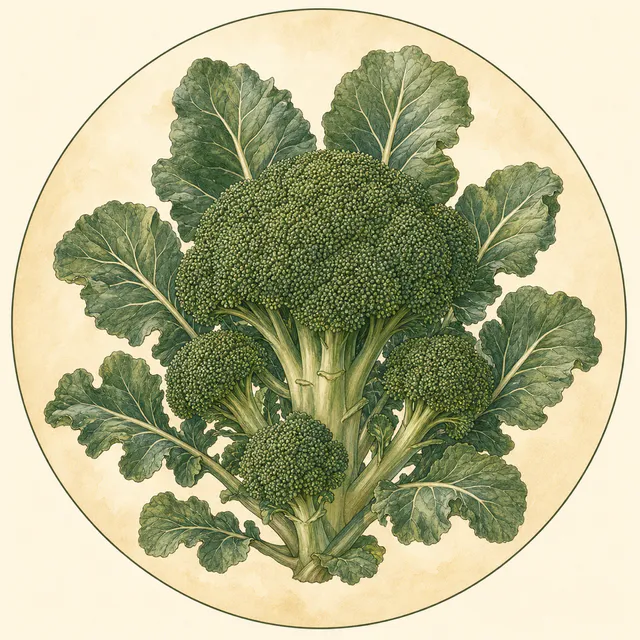
‘Fiesta’ is an annual or biennial calabrese grown for its large, domed green central heads. It is a high-yielding cultivar whose crop runs from summer into autumn. Once the central head is cut, medium-sized heads continue to develop on the side-shoots.
Excellent heat tolerance makes ‘Fiesta’ particularly useful for summer cropping, when sensitive calabrese cultivars can bolt or lose quality. Its clump-forming plants combine a substantial first head with a worthwhile follow-on harvest.
Size
- Ultimate height
- 0.1–0.5 metres
- Ultimate spread
- 0.1–0.5 metres
- Time to ultimate size
- 1 year
Although the profile gives broad mature dimensions, the crop reaches harvest within its first growing season. Give each plant enough room to form its central dome and later side-shoots without crowding neighbouring foliage.
Growing conditions
- Suitable soils
- Clay, loam and sand
- Moisture
- Moist but well-drained or well-drained
- Soil pH
- Neutral or alkaline
‘Fiesta’ accepts a wide range of soil textures, provided the ground is fertile, firm and drains freely. Neutral to alkaline conditions suit the cultivar and are preferable to acidic brassica ground where club root is more troublesome.
Position and hardiness
- Light
- Full sun
- Aspect
- South- or west-facing
- Exposure
- Sheltered
- Hardiness
- H3 — hardy in coastal and relatively mild UK conditions, while still grown and harvested as a warm-season annual crop
Choose a sunny, sheltered bed where steady warmth can support the cultivar’s summer performance. Protection from strong wind is useful as the central head enlarges and makes plants top-heavy.
Colour and seasonal interest
The live profile does not assign seasonal flower, foliage or fruit colours. Its description identifies the edible crop as large, domed green heads produced from summer into autumn, followed by green side-shoot heads after the main harvest.
Botanical details
- Family
- Brassicaceae
- Native to Great Britain and Ireland
- No
- Foliage
- Deciduous
- Habit
- Clump-forming
- Name status
- Unresolved
How to grow
Cultivation
Grow ‘Fiesta’ in full sun in fertile, firmly compacted, non-acid soil. Sow thinly from April to June, placing seed 1cm deep in rows 30cm apart. The profile gives an August-to-October harvest period. Cut the central head while its buds remain tight, then continue gathering the medium-sized side-shoot heads.
Propagation
Propagate by seed, either sown indoors or raised outdoors using standard vegetable-sowing methods.
Pruning
No pruning is required. Harvesting the central head is the productive cut that encourages the plant to develop its later side-shoot crop.
Pests
The profile lists possible damage from birds, cabbage caterpillars, cabbage root fly, cabbage whitefly, cutworms, flea beetles, mealy cabbage aphid, slugs and snails, and swede midge. A securely fitted fine mesh barrier excludes several of these pests while plants establish and form heads.
Diseases
Possible diseases include black rot, club root, grey moulds, leaf spot, white blister and downy mildews. Crop rotation, non-acid well-drained soil, clean plants and good spacing all support disease prevention.