
Salad Leaves · Variety guide
Valerianella locusta ‘Cavallo’
Cornsalad ‘Cavallo’
This Allotment Pro editorial draft summarises the cited RHS cultivar profile and its linked crop guidance. Check the sources and adjust cultivation decisions for local conditions.Read the original RHS source
Overview
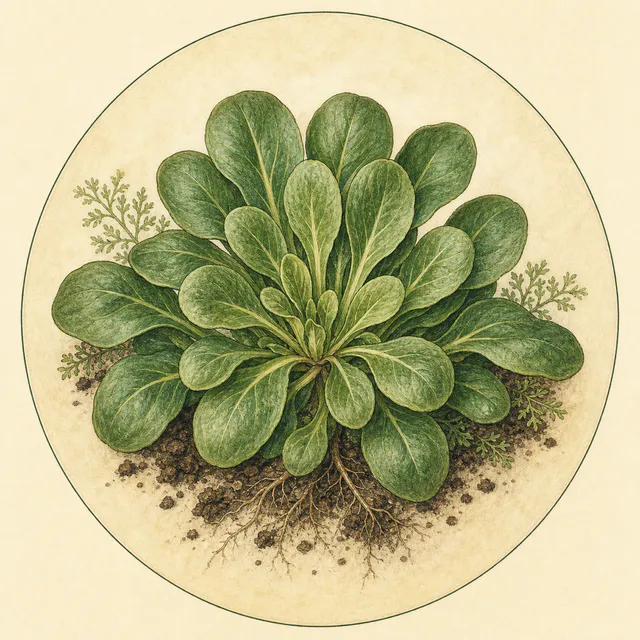
‘Cavallo’ is a compact, winter-hardy cornsalad, also known as lamb’s lettuce. It forms low rosettes of broad, spoon-shaped green leaves with a mild, pleasant flavour. The traditional long-leaved type gives a good yield under frames and is particularly useful for autumn and winter salads when many tender leafy crops are unavailable.
The plant is an annual or biennial but is harvested young, before it sends up flower stems. Its compact habit, cold tolerance and small footprint suit succession sowing in open ground, cold frames, windowboxes and containers.
Size
- Ultimate height
- Up to 10cm before flowering
- Ultimate spread
- Up to 10cm
- Time to ultimate size
- One year
- Habit
- Low, tufted rosette
- Harvest form
- Individual outer leaves or alternate whole plants
The small rosettes can be grown closely for baby leaves, then thinned by pulling alternate plants. Remaining rosettes gain room to produce larger spoon-shaped foliage for repeat picking.
Growing conditions
- Suitable soils
- Chalk, clay, loam or sand
- Moisture
- Moist but well drained
- Preferred pH
- Acid, alkaline or neutral
Grow in moderately fertile soil that stays evenly moist without becoming waterlogged. Add mature compost before sowing and maintain reliable moisture while seedlings establish. Containers should drain freely but not dry out, especially beneath a cold frame or cloche.
Position and hardiness
- Light
- Full sun
- Aspect
- East-, south- or west-facing
- Exposure
- Sheltered
- Hardiness
- H4 on the current plant profile; winter hardy through average UK conditions
Although hardy, cloches or cold frames improve the quality and reliability of autumn and winter crops by protecting leaves from persistent rain, severe exposure and soil splash. Ventilate covers on mild days to avoid stagnant humidity.
Colour and seasonal interest
Compact rosettes remain fresh green through spring, summer, autumn and winter when conditions allow. Each leaf is broad near its rounded end and narrows toward the base, creating the characteristic spoon shape. ‘Cavallo’ is a traditional longer-leaved selection and should appear as a neat cluster rather than an upright lettuce head.
If allowed to mature, Valerianella produces branched upright stems carrying small clusters of tiny bluish or pinkish flowers. For salad production, harvest before this stage so the foliage stays tender.
Botanical details
- Family
- Caprifoliaceae
- Native to Great Britain and Ireland
- No
- Foliage
- Deciduous
- Habit
- Tufted
- Name status
- Unresolved
- Life cycle
- Annual or biennial
How to grow
Cultivation
Sow thinly in shallow drills or containers in prepared, moisture-retentive soil. For a steady supply, make small batches rather than one large sowing. Protect autumn and winter crops with a cloche or cold frame, watering early in the day and ventilating in mild weather.
Thin by harvesting alternate plants once rosettes begin to crowd. Thereafter, pick the largest outer leaves as required while leaving the centre to continue growing. Harvest in the morning and use promptly because baby leaves wilt quickly.
Propagation
Propagate from seed. Cover lightly, keep moist through germination and avoid crowding. Autumn sowings are especially valuable for protected winter leaves, while spring sowings provide a quick mild crop before hot weather encourages flowering.
Suggested locations
- Cold frame or cloche bed
- Allotment salad-leaf row
- Patio pot or windowbox
- Cottage or informal kitchen garden
- Protected greenhouse border
Pruning
No pruning is required. Harvest outer leaves or whole alternate rosettes. Remove plants when flower stems appear and replace them with a fresh succession.
Pests
May be susceptible to slugs and snails, which can hide beneath the low foliage. Protect seedlings and inspect the centre and underside of harvested rosettes.
Diseases
May be susceptible to grey mould in crowded, humid conditions. Space or thin plants, remove decaying foliage, ventilate protection and avoid leaving leaves wet overnight.