
Jerusalem artichokes · Variety guide
Helianthus tuberosus ‘Dwarf Sunray’
Jerusalem artichoke ‘Dwarf Sunray’
This Allotment Pro editorial draft summarises the cited RHS cultivar profile and its linked crop recommendation. Check the sources and adjust cultivation decisions for local conditions.Read the original RHS source
Overview
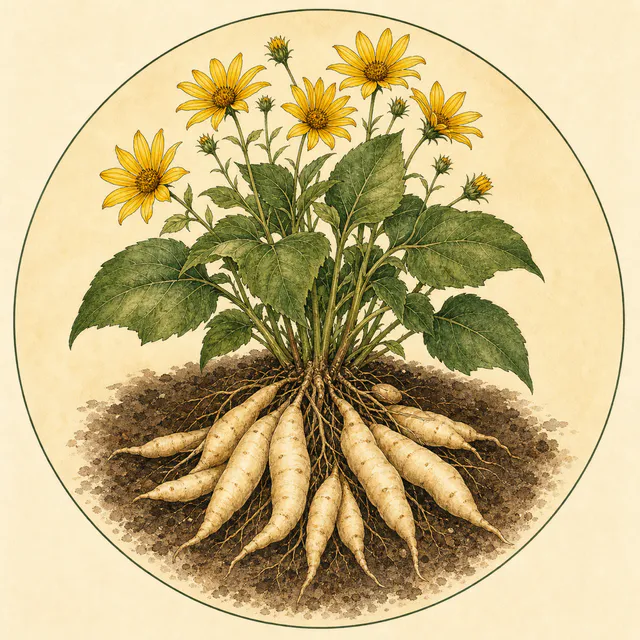
‘Dwarf Sunray’ is an accepted cultivar of the tuberous perennial sunflower Helianthus tuberosus. It is the compact Jerusalem artichoke recommended by the RHS for exposed sites, reaching about 120–150cm rather than the 3m possible in the crop. It produces long, smooth, pale edible tubers.
The shorter stems reduce wind exposure and suit smaller plots or large containers. Above ground, expect the coarse simple leaves and daisy-like flower heads typical of Helianthus. Below ground, the elongated pale tubers are the cultivar's most useful visual and culinary identifier.
Size
- Cultivar height
- About 120–150cm (4–5ft)
- Ultimate spread
- Not published on the exact cultivar record
- Time to ultimate size
- Not published on the exact cultivar record
Although compact for a Jerusalem artichoke, this is still a substantial herbaceous plant. Allow room for the leafy clump and spreading underground tubers, and use its shorter height where taller cultivars would shade nearby crops or catch strong wind.
Growing conditions
The exact cultivar record does not publish a soil, moisture or pH range. Follow the linked Jerusalem artichoke guidance: use moderately fertile, moisture-retentive but non-waterlogged soil. Full sun supports the best yield, while partial shade is tolerated. A large container can confine the tubers and is particularly appropriate for this compact cultivar.
Position and hardiness
The cultivar record does not assign aspect, exposure or hardiness fields. Its recommendation for exposed sites is based on its shorter 120–150cm stems. Jerusalem artichoke tubers are generally very hardy and can remain in the ground through winter, protected with mulch where frozen soil would prevent harvesting.
Colour and seasonal interest
Coarse green leaves grow on upright stems through the active season. Daisy-like yellow flower heads may appear in late summer or autumn. The edible crop consists of long, smooth, pale tubers, which should be the dominant identifier in an illustration. Flowers may be removed where maximum tuber swelling is the priority.
Botanical details
- Family
- Asteraceae
- Native to Great Britain and Ireland
- No
- Name status
- Accepted
How to grow
Cultivation
Plant firm tubers in late winter or spring, 10–15cm deep and 30cm apart, in fertile moisture-retentive soil that does not waterlog. Water during summer drought so tubers remain long and smooth rather than becoming small and knobbly. Mulch after planting. The shorter stems need less intervention than 2–3m cultivars but may still benefit from earthing up or support on a very windy site.
Propagation
Propagate by replanting sound, smooth tubers. Large tubers can be divided if every section retains at least one bud.
Suggested locations
- Exposed edible plot
- Small allotment bed
- Large patio container
- Sunny or partly shaded productive border
Pruning
Remove flower heads if prioritising tuber yield. Once foliage yellows in autumn, cut stems to about 8cm so the remaining stumps mark the underground crop.
Pests
Slugs and snails may damage young shoots or feed on overwintering tubers.
Diseases
Sclerotinia disease can affect Jerusalem artichokes. Avoid waterlogged soil and remove infected material promptly.