
Kale · Variety guide
Brassica oleracea (Acephala Group) ‘Redbor’ AGM
Borecole ‘Redbor’ AGM
This Allotment Pro editorial draft summarises the cited RHS cultivar profile. Check the source and adjust cultivation decisions for local conditions.Read the original RHS source
Overview
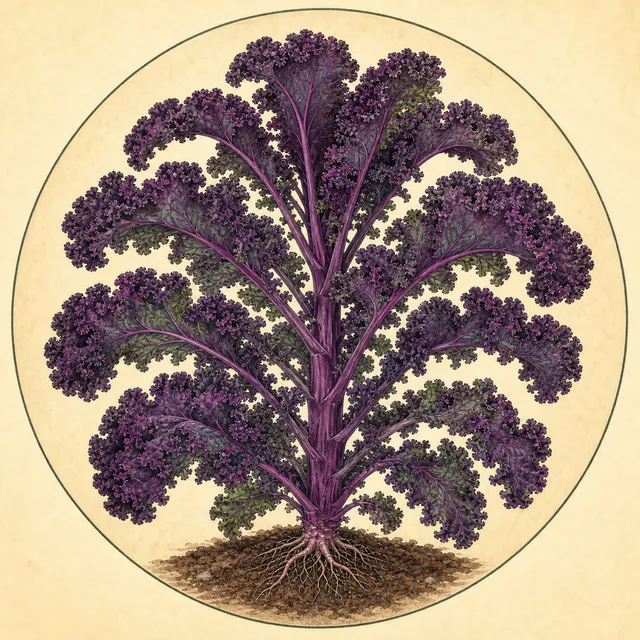
‘Redbor’ is a tall, sturdy curly kale grown for intensely curled, rich purple leaves with excellent flavour. The hardy open plants bring strong colour to vegetable plots and ornamental borders, then continue producing through winter when fresh garden leaves are scarce. Young tender leaves are the best harvest.
The cultivar combines a clump-forming habit with strongly curled purple to purple-green foliage. It shows good resistance to pests and diseases while remaining a highly ornamental edible crop. The RHS profile displays an Award of Garden Merit.
Size
- Ultimate height
- 0.5–1 metre
- Ultimate spread
- 0.1–0.5 metre
- Time to ultimate size
- 1 year
‘Redbor’ is tall relative to compact borecoles but keeps a narrow footprint. Space plants generously enough for their open crowns to receive light and air, and anchor them firmly because winter wind can buffet the leafy stems.
Growing conditions
- Suitable soils
- Sand or loam
- Moisture
- Well-drained
- Soil pH
- Neutral or alkaline
Grow in fertile soil that holds useful moisture without waterlogging. Add organic matter before planting, maintain steady water during establishment and avoid acidic or poorly drained ground.
Position and hardiness
- Light
- Full sun
- Aspect
- South- or west-facing
- Exposure
- Sheltered
- Hardiness
- H5 — hardy in most UK places even through severe winters
Full sun intensifies the ornamental effect of the purple crown and supports sturdy growth. The H5 rating makes ‘Redbor’ a dependable winter crop. A sheltered position or cane support protects tall mature plants from gales.
Colour and seasonal interest
The main feature is a tall open crown of intensely curly leaves in saturated purple, with purple-green undertones and prominent coloured veins. The dense curling should extend across each blade and margin. Winter cold does not remove the colour, so the plant remains decorative while supplying edible leaves.
Botanical details
- Family
- Brassicaceae
- Native to Great Britain and Ireland
- No
- Foliage
- Deciduous
- Habit
- Clump forming
- Name status
- Accepted
How to grow
Cultivation
Sow indoors in mid-spring, then prick seedlings into modules or individual pots. Transplant outdoors from May to July into fertile, moist but well-drained soil in full sun, arranging rows 60cm apart. Water well, especially while plants establish, and cover with netting against birds and insects.
Harvest leaves while young and tender, beginning at the lower part of the crown and keeping the central growing point intact. Remove old yellow foliage promptly. Winter picking can continue as new leaves develop.
Propagation
Propagate by seed. Sow about 1cm deep and transplant without disturbing the young root ball.
Suggested locations
- Winter vegetable plot
- Ornamental edible border
- Patio or large container planting
- Sheltered sunny bed
Pruning
No pruning is required. Remove yellowing lower leaves and harvest regularly to maintain a clean productive crown.
Pests
May be susceptible to birds, cabbage whitefly, cabbage gall weevil, cabbage caterpillars, cutworms, slugs and snails, swede midge, mealy cabbage aphid and flea beetles.
Diseases
The cultivar shows good general disease tolerance but may still be susceptible to black root, downy mildew, foot and root rot, grey mould, leaf spot and white blister.