
Radishes · Variety guide
Raphanus sativus ‘Black Spanish Round’
Radish ‘Black Spanish Round’
This Allotment Pro editorial draft summarises the cited RHS cultivar profile and its linked crop guidance. Check the sources and adjust cultivation decisions for local conditions.Read the original RHS source
Overview
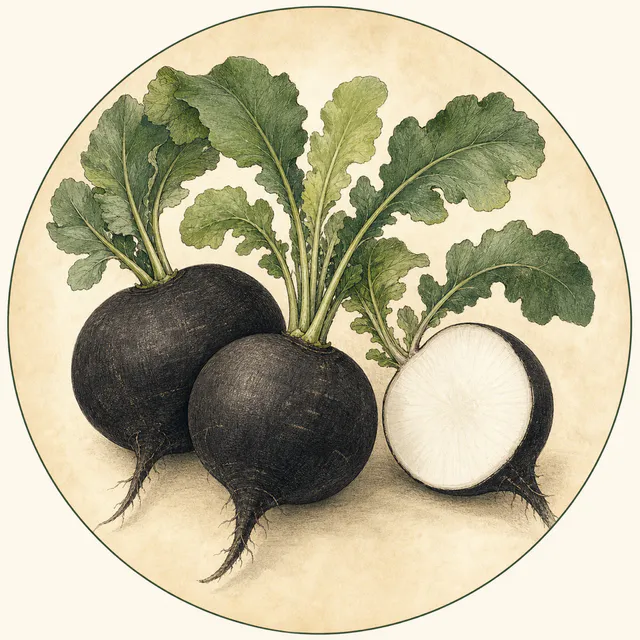
‘Black Spanish Round’ is an unresolved late-maturing heritage winter radish. It forms a round root with unusually dark black skin surrounding crisp white flesh with a distinctly sharp flavour. Sow during July or August for an autumn crop that can continue into winter.
Unlike quick, small salad radishes, this cultivar is allowed to become substantially larger and remains useful at maturity. Its dramatic black-and-white contrast, round form and cool-season harvest are the defining characteristics for both the gardener and the variety illustration.
Size
- Ultimate height
- up to 10cm, as recorded by the current profile
- Ultimate spread
- 0.1–0.5 metre
- Time to maturity
- one year
- Root
- medium to large, round, black-skinned and white-fleshed
- Habit
- tufted
Space plants around 15–20cm apart so the broad root shoulders and leafy tops can expand. Although the recorded top height is low, the root needs loose soil beneath it and enough surface room to mature without competition.
Growing conditions
- Suitable soils
- Chalk, clay, loam or sand
- Moisture
- Moist but well drained
- Preferred pH
- Acid, neutral or alkaline, while avoiding strongly acidic soil
Prepare fine, stone-free, moisture-retentive soil that drains freely. Maintain steady moisture so roots swell evenly and remain crisp. Drought followed by heavy watering may split the roots, while overcrowding prevents satisfactory size.
Position and hardiness
- Light
- Full sun
- Aspect
- East-, north-, south- or west-facing
- Exposure
- Exposed or sheltered
- Hardiness
- H2
The profile accepts all aspects and either open or protected positions in full sun. H2 plants tolerate low temperatures only above freezing, so protect roots left in the ground with fleece, cloches or cardboard during hard frost.
Colour and seasonal interest
At edible maturity, a low tuft of lyrate green leaves rises from a large, nearly spherical to slightly flattened root. The surface should be matte charcoal-black to near-black, slightly rougher than a glossy salad radish, with a fine taproot. A clean cut section reveals solid crisp white flesh, making the contrast unmistakable. The plate should avoid red, purple or pink shoulders and should not show flowering stems.
Botanical details
- Family
- Brassicaceae
- Native to Great Britain and Ireland
- No
- Foliage
- Deciduous
- Habit
- Tufted
- Name status
- Unresolved
- Life cycle
- Annual crop, within an annual or biennial species
How to grow
Cultivation
Sow in July or August about 2cm deep, with rows approximately 15cm apart. Thin promptly to 15–20cm between plants. Do not sow too early, because long summer days and stress may cause winter radishes to bolt before forming useful roots.
Water regularly and weed carefully by hand near the shoulders. Harvest from autumn, lifting as required through mild winter weather. Protect an in-ground crop when freezing conditions threaten, or lift in November and store in a refrigerator or similarly cool place.
Propagation
Propagate by seed sown directly where the root will mature.
Suggested locations
- Allotment winter-root bed
- Deep raised bed
- Open productive garden
- Cool-season succession plot
Pruning
No pruning is required. Remove premature flower stalks from an edible-root crop.
Pests
May be susceptible to slugs and snails and to flea beetles. Slower winter roots may also be damaged by cabbage root fly, so fine insect-proof mesh is useful.
Diseases
May be susceptible to brassica downy mildew. Rotate brassica crops, allow airflow and remove badly affected foliage.