
Peas · Variety guide
Pisum sativum ‘Jaguar’
Pea ‘Jaguar’
This Allotment Pro editorial draft summarises the cited RHS cultivar profile and its linked crop guidance. Check the sources and adjust cultivation decisions for local conditions.Read the original RHS source
Overview
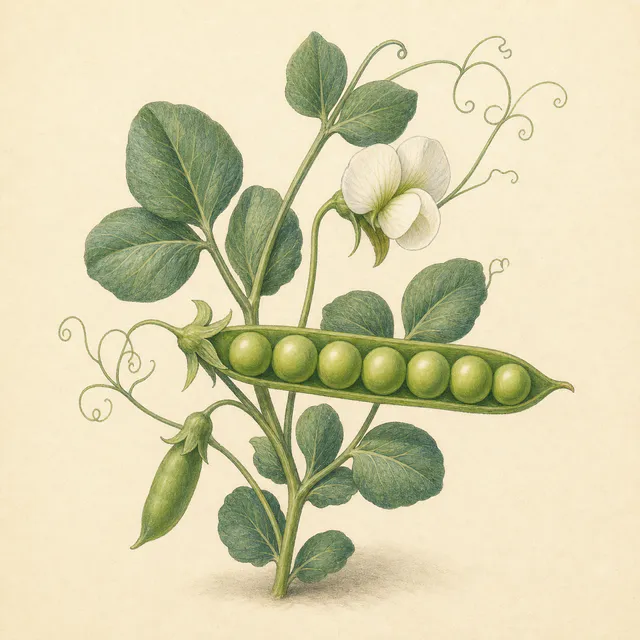
‘Jaguar’ is an AGM second-early garden pea grown for shelling. It reaches about 70cm and produces green pods containing six or seven peas. Resistance to powdery mildew is its most useful health distinction, especially as closely spaced or drought-stressed peas move into warmer weather.
Its compact height needs less support than a tall maincrop, while its second-early timing bridges the gap between the first peas and longer-season cultivars.
Size
- Ultimate height
- about 70cm
- Ultimate spread
- 0.1–0.5 metre
- Time to maturity
- approximately 13–14 weeks as a second early
- Pod contents
- usually six or seven peas
Space seed about 7.5cm apart. Use twiggy sticks or low netting capable of holding the complete crop upright.
Growing conditions
- Suitable soils
- Fertile chalk, clay, loam or sand with good structure
- Moisture
- Moist but well drained
- Preferred pH
- Acid, alkaline or neutral
Improve the bed with mature compost before sowing. Keep roots steadily moist at flowering and pod filling without saturating the soil or wetting foliage repeatedly.
Position and hardiness
- Light
- Full sun
- Aspect
- East-, south- or west-facing
- Exposure
- Sheltered
- Hardiness
- H2
Outdoor seed germinates reliably once soil reaches about 10°C. Indoor modules are useful for the earliest batch where spring ground is cold and wet.
Colour and seasonal interest
Compact climbing green stems carry paired rounded leaflets and curling tendrils. White pea flowers are followed by neat medium-green shelling pods, each swelling around a short row of six or seven rounded peas.
Botanical details
- Family
- Fabaceae
- Native to Great Britain and Ireland
- No
- Foliage
- Deciduous
- Habit
- Compact climbing annual
- Name status
- Accepted
How to grow
Cultivation
Sow from March to June, 5cm deep and about 7.5cm apart, once outdoor soil is near 10°C. A 15cm-wide flat-bottomed trench with three staggered rows suits compact peas. Add low supports immediately and protect emerging plants from mice, pigeons, slugs and snails.
Water well when flowers open and again two weeks later. Pick full green pods every few days after the second-early crop matures, holding the stem while removing each pod. Use peas promptly or blanch and freeze a surplus.
Propagation
Propagate by seed, either directly or in deep modules for transplanting at about 20cm tall.
Suggested locations
- Compact vegetable plot
- Supported raised bed
- Cottage or informal garden
- Large container
- Successional pea row
Pruning
No pruning is required. Regular picking maintains production. Cut finished stems at soil level.
Pests
Mice may take seed; pigeons, slugs and snails damage seedlings; pea moth may enter pods. Protect at the relevant stage.
Diseases
‘Jaguar’ is resistant to powdery mildew. Preserve airflow and even root moisture because resistance is not immunity, and rotate peas to limit soil-borne disease.