
Radishes · Variety guide
Raphanus sativus ‘Longipinnatus’
Chinese radish
This Allotment Pro editorial draft summarises the cited RHS cultivar profile and its linked crop guidance. Check the sources and adjust cultivation decisions for local conditions.Read the original RHS source
Overview
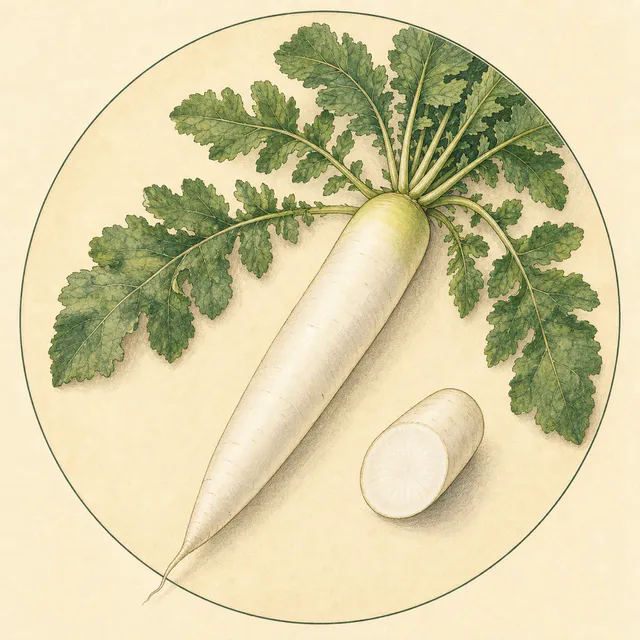
‘Longipinnatus’ is an unresolved annual Japanese-type radish or mooli, also called daikon, Japanese radish, mouli, mula or muli. It produces a firm, very long white root for harvesting in autumn and early winter. Under good conditions the tapering root reaches 30cm or more.
Unlike small round salad radishes, this oriental type is slower and needs deep, stone-free soil. It is mild enough to eat raw but can also be cooked like a winter radish. Its long white form, cool-season harvest and compact tuft of foliage are the essential cultivar characteristics.
Size
- Ultimate height
- up to 10cm, as recorded by the current profile
- Ultimate spread
- 0.1–0.5 metre
- Time to maturity
- one year
- Root
- firm, white, tapering and 30cm or longer
- Habit
- tufted
The edible root extends far below the profile's recorded top-growth height, so prepare at least 30cm of loose soil. Give plants around 15–20cm spacing to allow the foliage and root shoulders to develop without competition.
Growing conditions
- Suitable soils
- Chalk, clay, loam or sand
- Moisture
- Moist but well drained
- Preferred pH
- Acid, neutral or alkaline, while avoiding strongly acidic soil
Grow in moisture-retentive soil that drains freely. Break compacted layers and remove stones before sowing, because obstructions fork or bend the long root. Keep moisture even throughout growth to prevent toughness, splitting and excessive heat.
Position and hardiness
- Light
- Full sun
- Aspect
- East-, north-, south- or west-facing
- Exposure
- Exposed or sheltered
- Hardiness
- H2
The profile accepts any aspect and either open or sheltered exposure, provided the plant receives full sun. H2 indicates tolerance of low temperatures above freezing. Harvest or protect roots when hard frost threatens.
Colour and seasonal interest
A compact tuft of lyrate green leaves sits above an exceptionally long, smooth, firm white root. The root is broadest at the pale-green to white shoulder and tapers evenly to a fine tip. The profile records white seasonal stems from summer into winter, but an edible-stage illustration should avoid a flowering stem and focus on the intact 30cm-plus root and healthy leaves.
Botanical details
- Family
- Brassicaceae
- Native to Great Britain and Ireland
- No
- Foliage
- Deciduous
- Habit
- Tufted
- Name status
- Unresolved
How to grow
Cultivation
Sow directly in deep, finely prepared ground during spring or summer for an autumn or early-winter crop. Make drills about 2cm deep and thin seedlings promptly to 15–20cm apart, leaving about 15cm between rows. Avoid sowing too early if conditions encourage bolting.
Water regularly so the long roots grow rapidly and evenly. Weed by hand close to plants to avoid damaging the root shoulder. Allow at least eight weeks to mature, then loosen the surrounding soil with a fork before lifting so the long taper does not snap.
Propagation
Propagate by seed sown directly where the root will mature.
Suggested locations
- Deep allotment bed
- Stone-free raised bed
- No-dig bed with a deep fine surface layer
- Open productive garden
Pruning
No pruning is required. Remove any premature flower stem unless growing specifically for seed or edible pods.
Pests
May be susceptible to slugs and snails and to flea beetles. Protect seedlings and keep plants growing strongly.
Diseases
May be susceptible to brassica downy mildew. Allow airflow, avoid crowding and remove badly affected leaves.