
Salad Leaves · Variety guide
Beta vulgaris subsp. cicla var. flavescens ‘Bright Yellow’ AGM
Chard ‘Bright Yellow’
This Allotment Pro editorial draft summarises the cited RHS cultivar profile and its linked crop guidance. Check the sources and adjust cultivation decisions for local conditions.Read the original RHS source
Overview
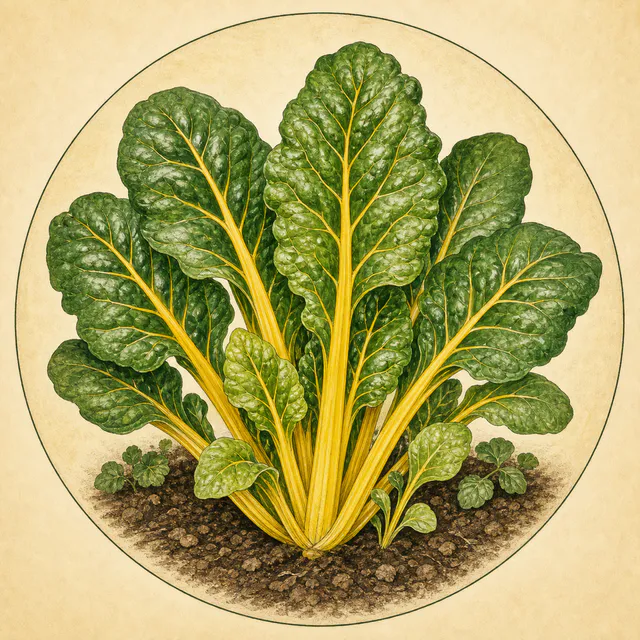
‘Bright Yellow’ is a striking chard grown for broad green leaves, vivid golden-yellow stems and a sweet flavour. It can be harvested young as colourful baby leaves for salads or allowed to mature for substantial stalks and cooked greens. The accepted cultivar is slow to bolt, has good winter hardiness and crops from midsummer into late autumn.
As a salad-leaf component, its yellow midribs provide a clear contrast to green, red and purple foliage. Repeat picking from the outside allows the central crown to continue producing new leaves.
Size
- Ultimate height
- 0.1–0.5 metres
- Ultimate spread
- 0.1–0.5 metres
- Time to ultimate size
- One year
- Habit
- Clump forming
- Harvest stages
- Baby leaf or mature chard
Space according to use: close sowing can supply baby leaves, while mature plants need enough room to develop broad blades and thick stalks. A large pot can support a small number of full-sized plants.
Growing conditions
- Suitable soils
- Clay, loam or sand
- Moisture
- Moist but well drained
- Preferred pH
- Alkaline or neutral
Grow in fertile, rich, freely drained soil with steady moisture. Add organic matter before sowing and water during dry spells so leaves remain tender. Container plants need regular checks because their compost dries faster.
Position and hardiness
- Light
- Full sun or partial shade
- Aspect
- East-, north-, south- or west-facing
- Exposure
- Sheltered
- Season
- Productive from midsummer to late autumn, with good winter tolerance
Partial shade is useful when the cultivar is grown for tender summer salad leaves, while sun supports strong stem colour. Its slow-bolting character improves reliability, but drought stress should still be avoided.
Colour and seasonal interest
Broad green leaves rise on exceptionally vivid yellow stalks, midribs and veins. The clear single-colour stems distinguish ‘Bright Yellow’ from rainbow chard mixtures and from white- or red-stemmed cultivars. Young leaves add yellow accents to salads; mature stalks become thicker without losing their characteristic colour.
The foliage makes an ornamental clump in edible borders and containers. Harvest before any flower stem develops to maintain the best eating quality.
Botanical details
- Family
- Amaranthaceae
- Native to Great Britain and Ireland
- No
- Foliage
- Deciduous
- Habit
- Clump forming
- Name status
- Accepted
- RHS recognition
- Award of Garden Merit
How to grow
Cultivation
Sow directly from March to July, about 2.5cm deep and initially 10cm apart, or sow in modules and transplant when seedlings are large enough to handle. For baby leaves, keep a closer succession and harvest young. For mature plants, thin more generously so each crown develops broad foliage.
Water in dry periods, keep weeds down and remove the oldest outer leaves cleanly at their base. Regular harvest encourages new growth from the centre. Young salad leaves may be picked once worthwhile; mature crops can continue from midsummer into late autumn.
Propagation
Propagate from seed. Make repeat sowings for a steady baby-leaf supply, or establish a smaller number of well-spaced plants for repeated mature harvests.
Suggested locations
- Allotment salad-leaf bed
- Patio or large container
- Productive flower border
- Cottage or kitchen garden
- Protected autumn crop
Pruning
No pruning is required. Harvest outer leaves and stalks at the base without damaging the central growing point. Remove any flower stem promptly and replace plants when leaf quality declines.
Pests
Birds may damage seedlings, while slugs and snails feed on young leaves. Protect new growth and inspect the bases of dense clumps.
Diseases
May be susceptible to grey mould and downy mildew. Avoid crowding, maintain airflow, remove fading foliage and water the soil early in the day rather than wetting leaves overnight.