
Shallots · Variety guide
Allium cepa (Aggregatum Group) ‘Matador’
Shallot ‘Matador’
This Allotment Pro editorial draft summarises the cited RHS cultivar profile and its linked crop guidance. Check the sources and adjust cultivation decisions for local conditions.Read the original RHS source
Overview
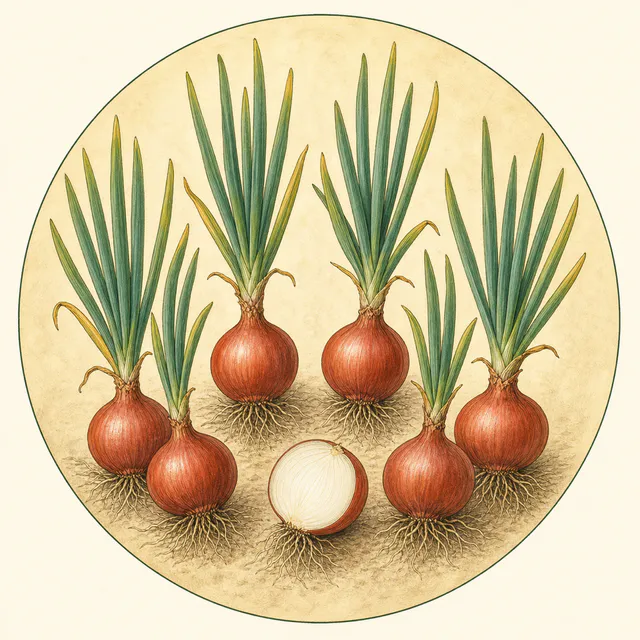
‘Matador’ is a high-yielding, seed-raised shallot that produces one bulb from each seed. The bulbs are round, with reddish-brown skins and crisp white flesh, and store well after ripening. Upright tubular, hollow bluish-green leaves make a compact crop above ground.
Harvest falls in early to mid-autumn, later than many set-grown shallots. The round shape and single-bulb seed habit distinguish it from clustered banana and teardrop cultivars.
Size
- Ultimate height
- 0.1–0.5 metres
- Ultimate spread
- 0–0.1 metre
- Time to ultimate size
- One year
- Habit
- Clump forming
Although botanically clump forming, each seed produces one compact rounded bulb. The narrow spread allows orderly rows while still leaving enough space for good airflow and bulb expansion.
Growing conditions
- Suitable soils
- Loam or sand
- Moisture
- Well drained
- Soil pH
- Alkaline or neutral
Grow in fertile free-draining soil. Water well during dry active growth, then stop once bulbs are fully swollen so skins and necks mature for successful storage.
Position and hardiness
- Light
- Full sun
- Aspect
- South- or west-facing
- Exposure
- Sheltered
- Hardiness
- H3 — best suited to coastal and relatively mild parts of the UK
Full sun and shelter support the long seed-raised season and help the late crop ripen. In colder districts, start seed indoors so plants are strong before lengthening days initiate bulb formation.
Colour and seasonal interest
| Season | Flowers | Foliage | Bulbs |
|---|---|---|---|
| Spring | — | Bluish green | Developing |
| Summer | — | Bluish green | Swelling |
| Autumn | — | Yellowing, then deciduous | Red-brown skin, white flesh |
| Winter | — | — | Stored crop |
The harvest consists of uniform rounded bulbs wrapped in reddish-brown papery skin. Cutting through one reveals firm, crisp white layers, contrasting with the tubular bluish-green foliage of the growing plant.
Botanical details
- Family
- Amaryllidaceae
- Native to Great Britain and Ireland
- No
- Foliage
- Deciduous
- Habit
- Clump forming
- Name status
- Accepted
- RHS recognition
- Award of Garden Merit
How to grow
Cultivation
Grow in fertile, freely drained soil in full sun. Raise from seed early enough to establish strong plants by late spring. Keep the crop weed-free and watered during dry periods, but stop watering when bulbs are fully swollen. Harvest in early to mid-autumn as foliage yellows and flops, then dry completely before storage.
Propagation
Propagate from seed or onion sets; the defining commercial crop is seed raised, with one bulb produced per seed.
Suggested locations
- Allotment or kitchen garden
- Sunny raised bed
- Sheltered edible border
- Large patio container
Pruning
No pruning is required. Let foliage yellow and fall naturally before lifting.
Pests
May be susceptible to stem and bulb eelworm, leek moth and onion fly. Inspect leaves and bulb bases and use crop rotation and fine mesh where appropriate.
Diseases
May be susceptible to rusts, onion downy mildew and onion white rot. Maintain spacing and airflow, avoid wet foliage and saturated soil, and rotate alliums.