
Calabrese · Variety guide
Brassica oleracea (Italica Group) ‘Kabuki’
Calabrese ‘Kabuki’
This Allotment Pro editorial draft summarises the cited RHS cultivar profile. Check the source and adjust cultivation decisions for local conditions.Read the original RHS source
Overview
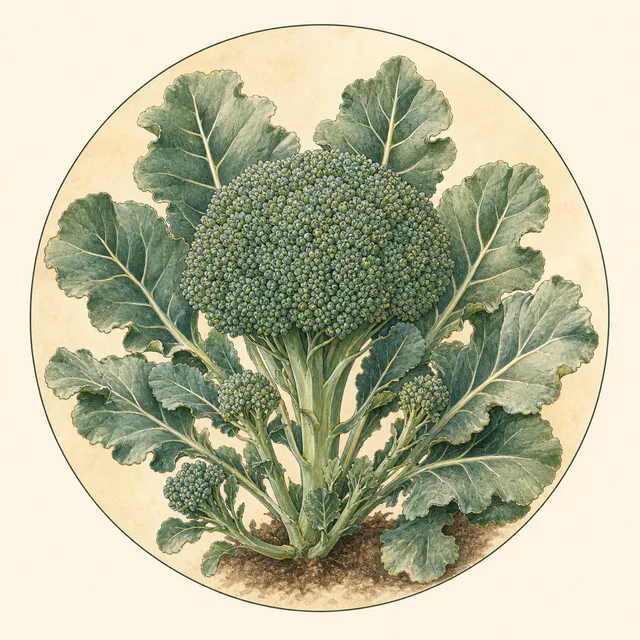
‘Kabuki’ is a compact, quick-maturing annual calabrese. It carries large, lobed and oblong blue-green leaves around a tight domed central head of densely packed blue-green flower buds. That head is harvested as calabrese or broccoli before any of the buds open.
Its compact habit suits close spacing and plots where a larger brassica would take up too much room. The parent crop guide highlights it as a particularly useful cultivar for autumn cropping, while the plant profile gives a late-summer main harvest followed by smaller shoots.
Size
- Ultimate height
- 0.1–0.5 metres
- Ultimate spread
- 0.1–0.5 metres
- Time to ultimate size
- 1 year
‘Kabuki’ reaches its useful size within one growing season. Although the profile uses a broad dimensional band, its defining compactness permits closer spacing than more expansive calabrese cultivars.
Growing conditions
- Suitable soils
- Chalk, clay, loam and sand
- Moisture
- Moist but well-drained
- Soil pH
- Alkaline or neutral
The cultivar tolerates all four common soil textures when the ground is fertile, firm and drains freely. Consistent moisture supports quick growth, while neutral or alkaline soil avoids the acidic conditions in which club root tends to be more severe.
Position and hardiness
- Light
- Full sun
- Aspect
- South- or west-facing
- Exposure
- Sheltered
- Hardiness
- H3 — hardy in coastal and relatively mild UK conditions, although cultivated and harvested as an annual vegetable
Plant in a sunny, sheltered position. Firm ground protects the roots as the dense head gains weight, and physical cover is useful against the birds and caterpillars listed on the profile.
Colour and seasonal interest
The live seasonal table does not assign individual colours. The overview describes blue-green foliage and a central head of densely packed blue-green flower buds; harvesting takes place before those buds open.
Botanical details
- Family
- Brassicaceae
- Native to Great Britain and Ireland
- No
- Foliage
- Deciduous
- Habit
- Clump-forming
- Name status
- Unresolved
How to grow
Cultivation
Grow ‘Kabuki’ in full sun in firm, fertile soil. Its compact habit makes close spacing practical, but retain enough airflow around the blue-green foliage. Harvest the tight central dome in late summer while every bud remains closed. Leave the rooted plant in place after cutting so its second crop of smaller shoots can develop.
Propagation
Propagate by seed, using standard indoor or outdoor vegetable-sowing methods and handling young roots carefully when transplanting.
Pruning
No pruning is required. The main cut is the harvest of the edible central head, which is followed naturally by smaller shoots.
Pests
The profile notes possible damage by birds and caterpillars. Cover young plants and developing heads with securely fixed fine mesh to prevent access.
Diseases
‘Kabuki’ may be susceptible to club root. Rotate brassicas, avoid poorly drained acidic soil and use healthy transplants to reduce the chance of severe infection.