
Salad Onions · Variety guide
Allium ‘Guardsman’ AGM
Salad onion ‘Guardsman’
This Allotment Pro editorial draft summarises the cited RHS cultivar profile and its linked crop guidance. Check the sources and adjust cultivation decisions for local conditions.Read the original RHS source
Overview
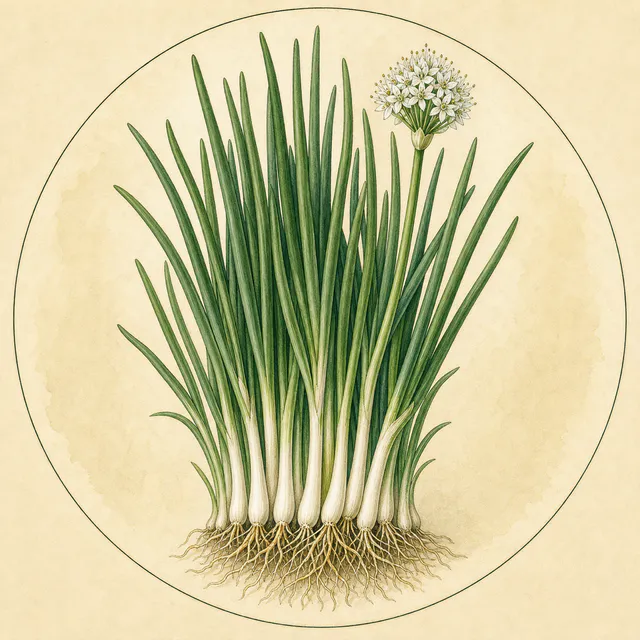
‘Guardsman’ is a vigorous, clump-forming bulbous perennial that is both edible and decorative. It produces high yields of upright, spring-onion-like shoots from late spring into autumn and is slow to form rounded bulbs, so the crop retains the long-stemmed character wanted from a salad onion.
Plants allowed to flower develop conical to rounded heads of small white blooms in midsummer. Where the priority is edible shoots, remove the heads before seed formation so the plant continues directing energy into fresh leaves and stems.
Size
- Ultimate height
- 0.5–1 metre
- Ultimate spread
- 0.1–0.5 metres
- Time to ultimate size
- 1–2 years
- Habit
- Clump forming
This is a taller, more vigorous salad onion than many quick annual selections. Space plants about 15cm apart so the upright clumps have room to build a sustained crop.
Growing conditions
- Suitable soils
- Loam or sand
- Moisture
- Well drained
- Soil pH
- Alkaline or neutral
Grow in rich, freely drained soil. Organic matter can improve moisture retention on light ground, but the root zone should not remain saturated. The upright habit also allows plants to fill gaps between other crops where light remains adequate.
Position and hardiness
- Light
- Full sun or partial shade
- Aspect
- South- or west-facing
- Exposure
- Exposed or sheltered
- Hardiness
- H3 — suitable for coastal and relatively mild parts of the UK
Full sun supports the strongest edible growth and flowering, although the profile also accepts partial shade. In colder districts, a sheltered site or container protection can help perennial clumps through winter.
Colour and seasonal interest
| Season | Flowers | Foliage | Edible shoots |
|---|---|---|---|
| Spring | — | Green | White and green |
| Summer | White | Green | White and green |
| Autumn | — | Green to fading | White and green |
| Winter | — | Deciduous or partly evergreen | — |
The tall green leaves and pale edible bases create an upright clump from late spring onward. In midsummer, small white flowers gather into conical to rounded allium heads above the foliage.
Botanical details
- Family
- Amaryllidaceae
- Native to Great Britain and Ireland
- No
- Foliage
- Deciduous or semi-evergreen
- Habit
- Clump forming
- Name status
- Accepted
- RHS recognition
- Award of Garden Merit
How to grow
Cultivation
Plant in rich, well-drained soil about 15cm apart, either in dedicated rows or between compatible crops to fill productive gaps. Harvest the spring-onion-like shoots from late spring through autumn. Water during dry spells and remove flower heads where sustained edible growth is more important than ornamental display or seed.
Propagation
Propagate from seed.
Suggested locations
- Cottage or informal garden
- Patio container
- Wildlife garden
- Productive mixed border
- Allotment or kitchen garden
Pruning
Deadhead to prevent the plant setting seed when it is being grown primarily as an edible crop.
Pests
May be susceptible to leek moth, onion fly and eelworm. Inspect leaves and bases regularly and use crop rotation to reduce persistent soil-borne problems.
Diseases
May be susceptible to bolting, bull neck, downy mildew, neck rot, rust and white rot. Maintain good drainage and airflow, avoid excessive nitrogen, and rotate allium crops.