
Turnips · Variety guide
Brassica rapa (Rapifera Group) ‘Oasis’ AGM
Turnip ‘Oasis’
This Allotment Pro editorial draft summarises the cited RHS cultivar profile.Read the original RHS source
Overview
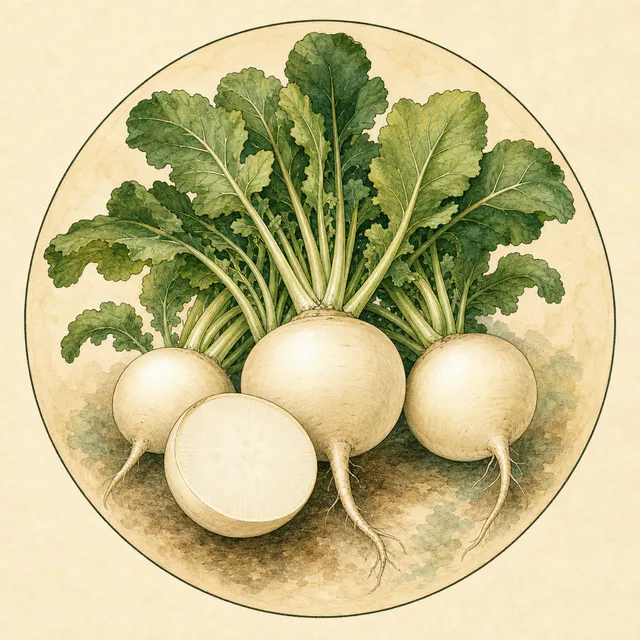
‘Oasis’ is a small uniform turnip with pure-ivory roots that can be harvested at any size. The juicy flesh has a sweet flavour compared by the profile to melon and can be eaten raw like an apple or grated into salads. It crops from late summer into autumn, has good disease resistance, suits containers and holds the RHS Award of Garden Merit.
Size
- Ultimate height
- 0.1–0.5 metres
- Ultimate spread
- 0.1–0.5 metres
- Time to ultimate size
- 1 year
The compact clump-forming top accompanies a uniform ivory taproot.
Growing conditions
- Suitable soils
- Fertile soil
- Moisture
- Moist but well drained or well drained
- Soil pH
- Neutral or alkaline
Consistent watering supports juicy flesh and steady root expansion.
Position and hardiness
- Light
- Full sun
- Aspect
- South- or west-facing
- Exposure
- Sheltered
- Hardiness
- H3 — hardy in coastal and relatively mild UK areas, approximately −5 to 1°C
A sheltered sunny container or bed suits this Japanese-type turnip.
Colour and seasonal interest
| Season | Foliage | Roots |
|---|---|---|
| Spring | Green | — |
| Summer | Green | Pure ivory |
| Autumn | Green declining | Uniform ivory roots |
The clean ivory root and juicy pale cut flesh are the visual identifiers.
Botanical details
- Family
- Brassicaceae
- Native to Great Britain and Ireland
- No
- Foliage
- Deciduous
- Habit
- Clump forming
- Name status
- Accepted
- Award
- RHS Award of Garden Merit
How to grow
Cultivation
Sow April to July at four-week intervals, 1cm deep in drills 30cm apart. Thin seedlings to 15cm. Grow in fertile moist but well-drained soil in full sun; containers are suitable.
Propagation
Propagate by seed.
Suggested locations
- Patios and containers
Pruning
No pruning is required.
Pests
Birds, cabbage caterpillars, cabbage root fly, flea beetles, slugs and snails may attack.
Diseases
Black rot, club root, downy mildew, grey mould and leaf spot are listed, although the cultivar has good general disease resistance.