
Garlic · Variety guide
Allium sativum ‘Cristo’ AGM
Garlic ‘Cristo’ AGM
This Allotment Pro editorial draft summarises the cited RHS cultivar profile. Check the source and adjust cultivation decisions for local conditions.Read the original RHS source
Overview
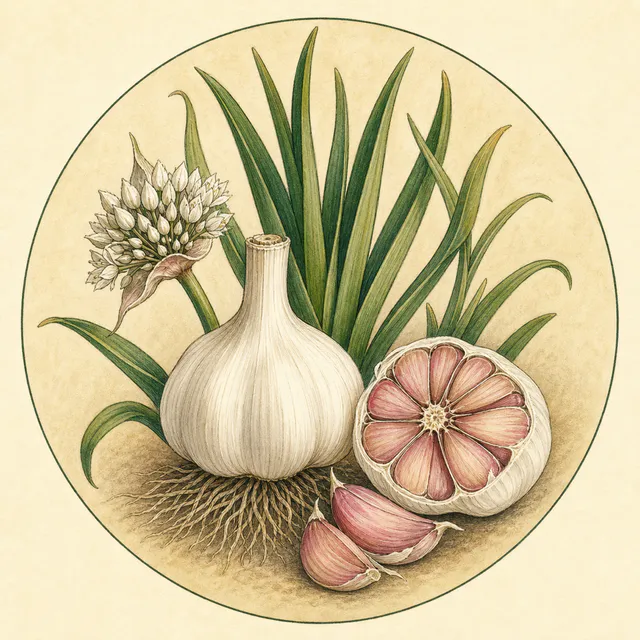
‘Cristo’ is a French softneck garlic grown for an even crop of attractive white-skinned bulbs. The flavour is strong while the aroma is comparatively mild. Beneath the pure white outer wrappers, the bulb contains pinkish cloves; an average bulb has about 12 cloves.
It can be planted in autumn or spring for a summer harvest and has good storage capability. The softneck habit and reliable keeping quality make it useful where a crop must continue supplying the kitchen after lifting. The RHS profile carries an Award of Garden Merit, reflected in the cultivar name used here.
Size
- Ultimate height
- 0.1–0.5 metre
- Ultimate spread
- 0.1–0.5 metre
- Time to ultimate size
- 1 year
Linear green leaves form a compact clump above the developing bulb. Give each plant enough room for the bulb and its approximately 12 cloves to size evenly rather than crowding plants for maximum numbers.
Growing conditions
- Suitable soils
- Chalk, loam or sand
- Moisture
- Well-drained
- Soil pH
- Neutral or alkaline
Although ‘Cristo’ can grow in various soils, fertile free-draining ground is preferred. Heavy, wet soil gives poorer results, particularly through winter. Improve drainage before autumn planting, and avoid sites where water gathers around the cloves.
Position and hardiness
- Light
- Full sun
- Aspect
- South-, east- or west-facing
- Exposure
- Exposed or sheltered
- Hardiness
- H4 — hardy through most of the UK
Full sun supports strong leaf growth and bulb formation. The H4 rating suits outdoor cultivation across most of the UK, but free drainage remains important in cold wet weather. An open or protected site can both be suitable when light and soil conditions are right.
Colour and seasonal interest
The narrow foliage is green during active growth. At harvest, ‘Cristo’ is identified by its clean pure white bulb wrappers and contrasting pinkish cloves. These pale, uniform bulbs are the cultivar’s clearest visual feature; flower heads are not needed to represent a crop normally lifted before flowering.
Botanical details
- Family
- Amaryllidaceae
- Native to Great Britain and Ireland
- No
- Foliage
- Deciduous
- Habit
- Clump forming
- Name status
- Accepted
How to grow
Cultivation
Separate the bulb shortly before planting. Set individual cloves 2.5cm below the soil surface, 15cm apart, leaving 30cm between rows. Plant in autumn or spring in fertile, well-drained soil and full sun. Water only during very dry spells. Harvest from July when the leaves begin to yellow, then dry the bulbs thoroughly before storage. The profile indicates a storage period of up to three months.
Propagation
Propagate by dividing a mature bulb into individual cloves and replanting sound cloves.
Suggested locations
- Sunny edible bed
- Cottage or informal garden
- Patio or container planting
Pruning
No pruning is required. Remove any flower stalks if the aim is to direct energy into the bulb, and lift the crop once the foliage signals maturity.
Pests
May be susceptible to allium leaf miner and onion fly. Rotation, prompt removal of affected material and crop protection can reduce damage.
Diseases
May be susceptible to onion white rot and onion downy mildew. Avoid waterlogged soil and rotate allium crops to reduce persistent disease pressure.