
Rhubarb · Variety guide
Rheum × hybridum ‘Raspberry Red’ AGM
Rhubarb ‘Raspberry Red’
This Allotment Pro editorial draft summarises the cited RHS cultivar profile and its linked crop guidance. Check the sources and adjust cultivation decisions for local conditions.Read the original RHS source
Overview
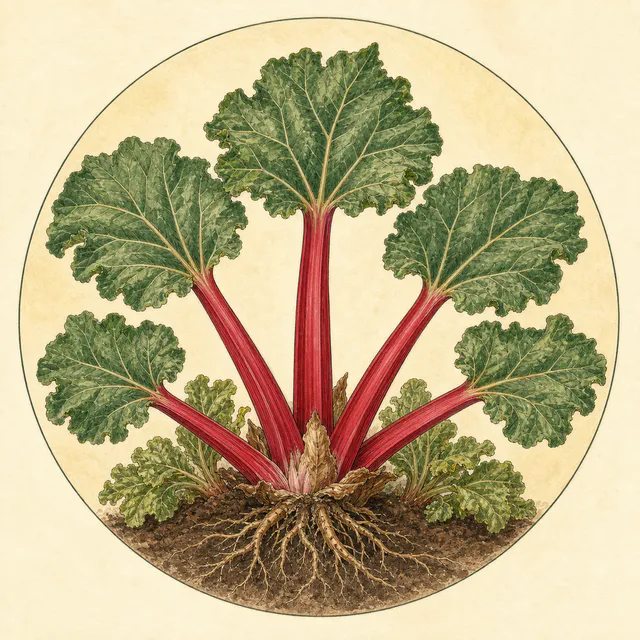
‘Raspberry Red’ is a prolific early rhubarb with an RHS Award of Garden Merit. It produces a heavy crop of rich-red, notably sweet stalks without needing to be forced. Harvest can begin in April and continue through June, while strong established crowns are also suitable for forcing.
Its early season, vivid colour and natural sweetness distinguish it from later green-flushed cultivars. The deciduous plant forms a productive bushy clump and is intended for a permanent fertile position.
Size
- Ultimate height
- 0.5–1 metre
- Ultimate spread
- 0.5–1 metre
- Time to ultimate size
- 2–5 years
- Habit
- Bushy
- Cropping season
- Early, April to June
Allow 75–90cm between crowns. A mature plant needs room for its broad leaves even though its recorded ultimate spread is moderate for rhubarb.
Growing conditions
- Suitable soils
- Chalk, clay, loam or sand enriched with organic matter
- Moisture
- Moist but well drained
- Preferred pH
- Acid, alkaline or neutral
Grow in deep, humus-rich soil that stays moist without waterlogging. Prepare the permanent bed with well-rotted organic matter, mulch in spring without covering the crown and water during dry summers. Even moisture supports the heavy early crop.
Position and hardiness
- Light
- Full sun or partial shade
- Aspect
- East-, south- or west-facing
- Exposure
- Exposed or sheltered
- Hardiness
- H5, hardy through severe winters in most UK locations
Full sun favours strong growth and stem colour, but partial shade is acceptable. Avoid frost pockets and stagnant wet ground. Winter cold helps the dormant crown initiate spring growth.
Colour and seasonal interest
The defining stalk colour is a saturated raspberry to rich red, paired with broad green leaves. The striking stems appear early and do not depend on blanching or forcing for their colour. The foliage forms a rounded spring and summer clump, then dies back naturally in autumn.
Botanical details
- Family
- Polygonaceae
- Native to Great Britain and Ireland
- No
- Foliage
- Deciduous
- Habit
- Bushy
- Name status
- Accepted
How to grow
Cultivation
Plant with the crown tip just above soil level, water through the first season and mulch each spring. Do not harvest in year one and take only a few stalks in year two. From year three, pull and twist stalks from the base once about 30cm long, taking no more than one-third at a time. Stop the main harvest by late June or early July.
Force only a strong established crown and never in consecutive years. Remove flowerheads promptly and divide congested plants about every five years.
Propagation
Divide healthy crowns in late autumn or early spring. Each section must retain a sound piece of rhizome and at least one growing point. Prefer vigorous outer pieces and discard decay.
Suggested locations
- Allotment or kitchen garden
- Productive perennial bed
- Cottage or informal garden
- Low-maintenance edible border
- Large container
Pruning
Remove flowerheads at the base. Allow foliage to die back in autumn, then clear it away to expose the buds to winter cold.
Pests
May be susceptible to stem and bulb eelworm, swift moth caterpillar, slugs and snails, especially on tender young growth.
Diseases
May be susceptible to honey fungus, downy mildew, grey mould, crown rot and virus diseases. Use healthy stock and maintain good drainage.