
Carrots · Variety guide
Daucus carota ‘Sweet Candle’
Carrot ‘Sweet Candle’
This Allotment Pro editorial draft summarises the cited RHS cultivar profile. Check the source and adjust cultivation decisions for local conditions.Read the original RHS source
Overview
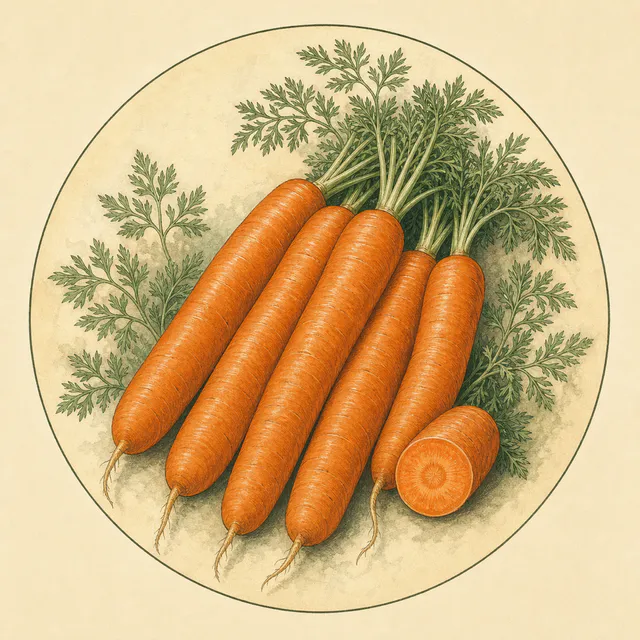
‘Sweet Candle’ is a popular, high-yielding annual carrot with smooth orange skin and an almost coreless interior. Its roots are consistently cylindrical with rounded tips, and their notably sweet flavour makes the cultivar attractive to both kitchen gardeners and exhibitors.
The profile gives a March-to-July sowing period and a harvest from July into October or November. Uniform root shape is one of the cultivar’s strongest visual identifiers, particularly when it is grown in deeply prepared, obstruction-free soil.
Size
- Ultimate height
- 0.1–0.5 metres
- Ultimate spread
- 0.1–0.5 metres
- Time to ultimate size
- 1 year
The listed dimensions cover the leafy clump as well as the useful root zone. ‘Sweet Candle’ completes its crop in the first growing season and is lifted before the plant follows its natural biennial flowering cycle.
Growing conditions
- Suitable soils
- Clay, loam and sand
- Moisture
- Moist but well-drained or well-drained
- Soil pH
- Acid, neutral or alkaline
This cultivar tolerates all common pH ranges and several soil textures, but root quality depends on deep, freely drained preparation. Remove stones and improve clay with well-rotted organic matter so the cylindrical roots can extend without forking.
Position and hardiness
- Light
- Full sun
- Aspect
- South- or west-facing
- Exposure
- Sheltered
- Hardiness
- H4 — hardy through an average UK winter, although normally cultivated and harvested as an annual root crop
Choose an open, sunny but sheltered plot. Full light supports strong foliage and root growth, while a fine seedbed and steady early moisture are more important to root uniformity than the plant’s broader cold tolerance.
Colour and seasonal interest
The live seasonal table does not assign individual colours. The cultivar description identifies smooth orange roots, while the genus characteristically produces divided, lacy green foliage. The edible root is harvested during its first year before flowers develop.
Botanical details
- Family
- Apiaceae
- Native to Great Britain and Ireland
- No
- Foliage
- Deciduous
- Habit
- Clump-forming
- Name status
- Accepted
How to grow
Cultivation
Grow ‘Sweet Candle’ in an open sunny position in deeply cultivated, well-drained soil. Remove stones, break up compacted ground and add well-rotted organic matter to heavy clay. Keep the seedbed watered until seedlings emerge. Containers are also suitable when they provide enough depth for the cylindrical roots. Harvest from July through October or November.
Propagation
Propagate by seed from March to July. Weed and de-stone the bed, firm and rake it level, then draw drills, water their bases and sow sparingly. Thin sowing reduces the need to disturb aromatic foliage later, which helps avoid attracting carrot fly. Cover the seeds with soil and water them in.
Suggested locations
- Patio and container plantings
- Cottage and informal gardens
- Wildlife gardens
Pruning
No pruning is required.
Pests
Roots may be damaged by carrot fly larvae, wireworm, slugs and rodents, while aphids may attack the foliage. The profile recommends a fine insect-mesh barrier at least 60cm high around the bed to help prevent carrot fly egg-laying.
Diseases
‘Sweet Candle’ is generally disease-free, but carrot leaf blight may occur during wet growing conditions.