
Radishes · Variety guide
Raphanus sativus ‘Amethyst’ AGM
Radish ‘Amethyst’
This Allotment Pro editorial draft summarises the cited RHS cultivar profile and its linked crop guidance. Check the sources and adjust cultivation decisions for local conditions.Read the original RHS source
Overview
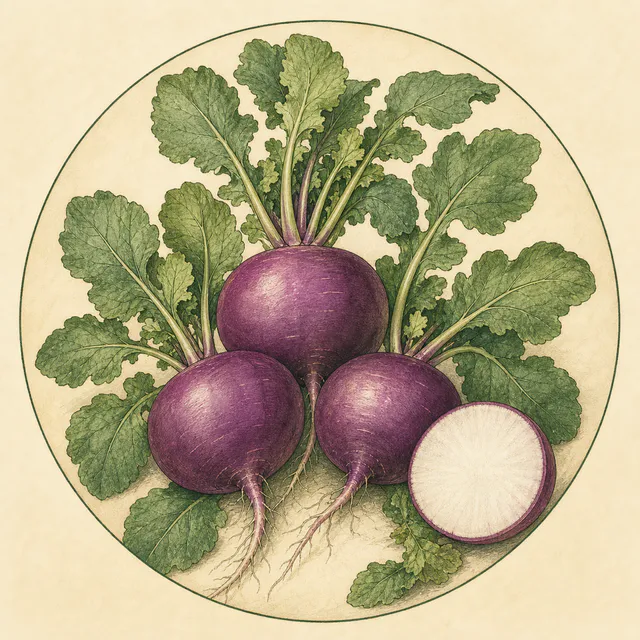
‘Amethyst’ is an accepted PBR-protected AGM salad radish. It is very fast maturing, producing round roots with attractive mauve-purple skin and crisp white flesh in about four weeks from sowing. The crop guide describes the flavour as tangy and notes that roots are slow to become woody.
Its rich purple colour, uniform shape and reliable texture add contrast to ordinary red salad radishes. It is compact enough for containers, gap crops and small successional rows.
Size
- Ultimate height
- up to 10cm
- Ultimate spread
- 0–0.1 metre
- Time to maturity
- one year botanically
- Edible harvest
- around four weeks from sowing
- Root
- uniform, round and mauve-purple with white flesh
- Habit
- tufted
Give roots about 3cm spacing and harvest at a small salad size. The unusually narrow recorded spread reflects the compact crop, although foliage still needs enough room and light for roots to swell.
Growing conditions
- Suitable soils
- Chalk, clay, loam or sand
- Moisture
- Moist but well drained
- Preferred pH
- Acid, neutral or alkaline, while avoiding strongly acidic ground
Use fine, moisture-retentive soil with free drainage. Water consistently to preserve the crisp flesh and prevent splitting. Avoid overcrowding, drought and stalled growth even though this cultivar resists woodiness better than many salad radishes.
Position and hardiness
- Light
- Full sun
- Aspect
- East-, north-, south- or west-facing
- Exposure
- Exposed or sheltered
- Hardiness
- H2
The profile accepts any aspect and either open or sheltered exposure in full sun. H2 indicates tolerance of cool conditions above freezing. Sow during suitable mild periods rather than attempting to hold mature salad roots through frost.
Colour and seasonal interest
At edible maturity, a compact tuft of lyrate green foliage rises from a smooth, round to subtly flattened root with saturated amethyst-purple or mauve skin and a fine taproot. A cut root reveals uniformly crisp white flesh. The illustration must avoid red skin, a white-tipped cylinder, black winter-root texture or a long daikon form. Do not include a flower stalk at harvest stage.
Botanical details
- Family
- Brassicaceae
- Native to Great Britain and Ireland
- No
- Foliage
- Deciduous
- Habit
- Tufted
- Name status
- Accepted
- Protection
- Plant Breeders’ Rights
- Award
- RHS Award of Garden Merit
How to grow
Cultivation
Sow small batches directly in finely prepared ground during spring, early summer and late summer. Make drills about 1cm deep, leave 15cm between rows and sow or thin seedlings to approximately 3cm apart. Keep soil evenly moist and weed carefully.
Begin checking at around four weeks. Pull roots while small, smooth and crisp; the cultivar is slow to turn woody, but prompt harvesting still gives the best tangy flesh. Repeat sowings every few weeks for continuity.
Propagation
Propagate by seed sown directly where the roots will mature.
Suggested locations
- Allotment succession row
- Patio container
- Raised or no-dig bed
- Small city or courtyard garden
Pruning
No pruning is required. Remove any prematurely flowering plant from an edible-root crop.
Pests
May be susceptible to slugs and snails and to flea beetles. Protect seedlings and keep growth steady.
Diseases
May be susceptible to brassica downy mildew. Avoid crowding, water at soil level and remove badly affected leaves.