
Peas · Variety guide
Pisum sativum ‘Terrain’
Pea ‘Terrain’
This Allotment Pro editorial draft summarises the cited RHS cultivar profile and its linked crop guidance. Check the sources and adjust cultivation decisions for local conditions.Read the original RHS source
Overview
‘Terrain’ is an AGM PBR climbing annual shelling pea that produces a heavy crop of sweet peas. It is a favourite for late-season harvests and combines that productivity with good disease resistance, including relative resistance to powdery and downy mildews.
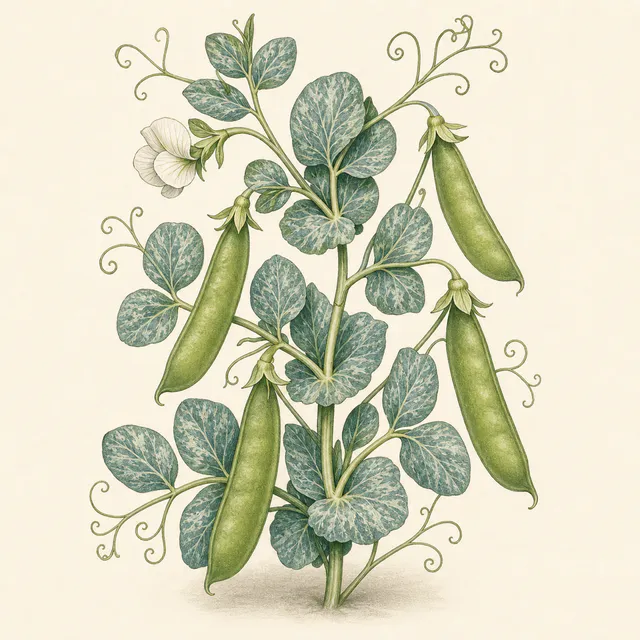
Plants carry attractive bluish-green foliage, often marbled grey-silver. This healthy late-season leaf canopy supports continued pod filling when more susceptible peas may decline.
Size
- Ultimate height
- 0.5–1 metre
- Ultimate spread
- 0.1–0.5 metre
- Time to maturity
- one year
- Crop type
- heavy late-season shelling crop
Use twiggy sticks or netting to the plant's full height. Sow at roughly 7cm spacing in a double row.
Growing conditions
- Suitable soils
- Chalk, clay, loam or sand
- Moisture
- Moist but well drained
- Preferred pH
- Acid, alkaline or neutral; preferably near neutral
Prepare humus-rich, moisture-retentive ground that drains freely. Maintain even root moisture through flowering and the late harvest.
Position and hardiness
- Light
- Full sun
- Aspect
- South- or west-facing
- Exposure
- Sheltered
- Hardiness
- H2
Sow from early spring to early summer once soil is warm. A sheltered sunny site assists late pods as days shorten.
Colour and seasonal interest
Climbing stems carry rounded bluish-green leaflets with characteristic grey-silver marbling and curling tendrils. White spring and summer flowers develop into abundant medium-green shelling pods filled with sweet peas.
Botanical details
- Family
- Fabaceae
- Native to Great Britain and Ireland
- No
- Foliage
- Deciduous
- Habit
- Climbing
- Name status
- Accepted
How to grow
Cultivation
Sow 5cm deep from early spring to early summer, approximately 7cm apart in a double row within a flat-bottomed drill 15cm wide. Support with twiggy sticks or netting and protect germinating seed and seedlings from mice, pigeons, slugs and snails.
Water when flowers open and again two weeks later, then prevent root-zone drought. Pick full green pods regularly through the late season to maintain the heavy crop and sweet flavour.
Propagation
Propagate by seed, directly or in deep modules for reliable early establishment.
Suggested locations
- Late-season vegetable plot
- Cottage or informal garden
- Supported raised bed
- Sunny edible border
- Successional pea row
Pruning
No pruning is required. Frequent harvesting encourages a continuous crop.
Pests
May be susceptible to pea moth, aphids, pea and bean weevil, thrips, pigeons, slugs, snails and mice. Protect plants at vulnerable stages.
Diseases
May be susceptible to foot and root rot, Fusarium wilt, grey mould, pea leaf and pod spot and viruses. ‘Terrain’ is relatively resistant to powdery and downy mildews; maintain spacing and rotation despite this advantage.