
Chinese Broccoli · Variety guide
Brassica oleracea (Italica Group) ‘Kailaan Express’
Calabrese ‘Kailaan Express’
This Allotment Pro editorial draft summarises the cited RHS cultivar profile. Check the source and adjust cultivation decisions for local conditions.Read the original RHS source
Overview
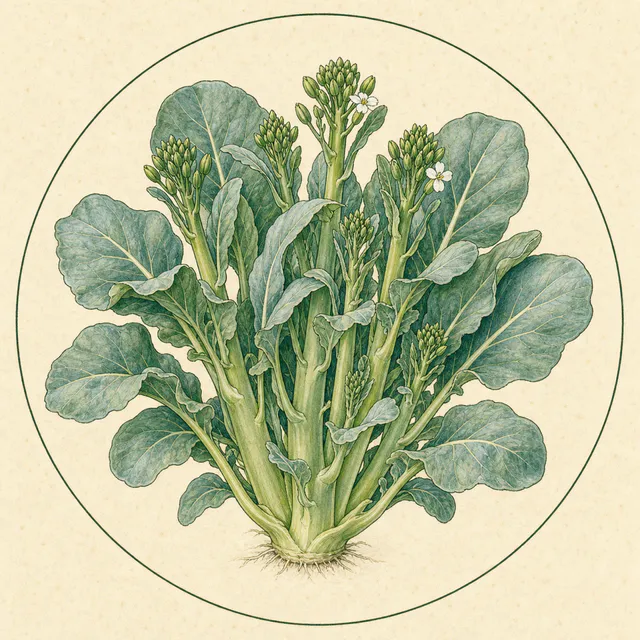
‘Kailaan Express’ is a fast-growing, reliable Chinese broccoli that the RHS profile classifies within the Italica Group of Brassica oleracea. It is a hardy biennial normally grown as an annual vegetable for its green leaves, succulent stems and young sprouting flower shoots.
Sowing can continue from spring until late summer, making the cultivar useful for succession cropping. Its speed and compact dimensions suit allotment beds as well as small productive plots where repeat harvests are more valuable than one large head.
Size
- Ultimate height
- 0.1–0.5 metre
- Ultimate spread
- 0.1–0.5 metre
- Time to ultimate size
- 1 year
Full-size plants should be thinned or transplanted to about 30cm apart. Keep rows around 40cm apart according to the cultivar profile so leaves and side shoots have adequate light and airflow.
Growing conditions
- Suitable soils
- Chalk, clay, loam and sand
- Moisture
- Moist but well-drained
- Soil pH
- Neutral or alkaline
Prepare fertile ground thoroughly and firm it before sowing or planting. The crop performs best when growth remains steady, so enrich light soil with mature compost and water during dry spells without leaving roots saturated.
Position and hardiness
- Light
- Full sun
- Aspect
- South- or west-facing
- Exposure
- Sheltered
- Hardiness
- H4 — hardy through most of the UK at approximately −10 to −5°C
Although mature plants tolerate cold well, expose seedlings gradually after indoor raising and protect young growth from harsh weather and pests. A bright open site supports compact leaves and prompt flowering-shoot production.
Colour and seasonal interest
The plant forms a bushy display of green, often lightly glaucous brassica leaves around upright fleshy green stems. Tight green flowering shoots develop toward the tips and should usually be cut young; if left, they open into small cross-shaped flowers typical of the cabbage family.
Botanical details
- Family
- Brassicaceae
- Group
- Italica Group
- Native to Great Britain and Ireland
- No
- Foliage
- Deciduous
- Habit
- Bushy
- Lifecycle
- Hardy biennial grown as an annual vegetable
- Name status
- Unresolved
How to grow
Cultivation
Sow thinly from spring to late summer in fertile, well-firmed neutral or alkaline soil in full sun. Arrange rows about 40cm apart and thin seedlings to 30cm for mature plants. For a continuous supply, make several small sowings rather than filling the whole row at once.
Keep the soil moist during dry spells and weed around young plants. Cover with fine insect-proof mesh before common brassica pests arrive. Harvest the tender central shoot before flowers fully open; cutting should encourage useful side shoots to develop.
Propagation
Propagate by seed, either sown directly or raised indoors in modules to minimise root disturbance.
Pruning
No pruning is required. Harvesting edible shoots provides the only routine cutting.
Pests
May be susceptible to cabbage root fly, cabbage caterpillars, cabbage whitefly and mealy cabbage aphid. Use securely fitted fine mesh and inspect leaf undersides and growing tips.
Diseases
May be susceptible to club root, brassica downy mildew and brassica white blister. Rotate brassicas, maintain drainage and airflow, and avoid moving contaminated soil between beds.