
Brussels Sprouts · Variety guide
Brassica oleracea (Gemmifera Group) ‘Red Bull’
Brussels sprout ‘Red Bull’
This Allotment Pro editorial draft summarises the cited RHS cultivar profile. Check the source and adjust cultivation decisions for local conditions.Read the original RHS source
Overview
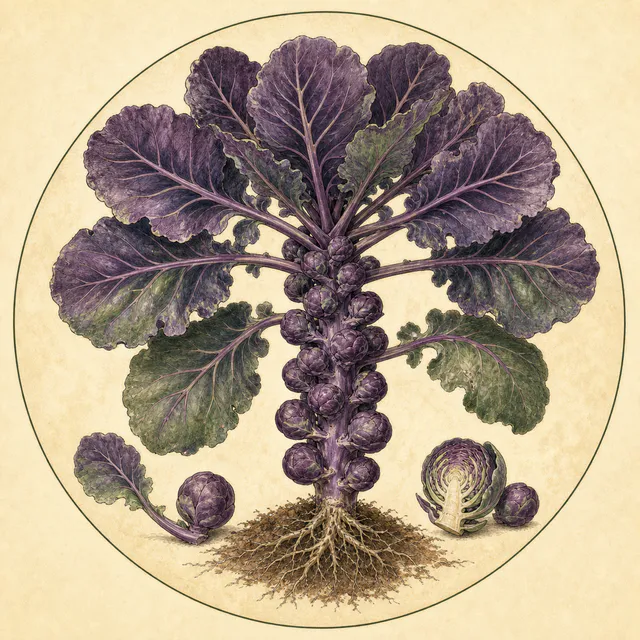
‘Red Bull’ is a distinctive purple Brussels sprout cultivar with a columnar, upright habit. It reaches up to about 1m and produces a good crop over a long season. Both its edible buttons and evergreen foliage provide a strong purple alternative to conventional green Brussels sprouts.
The plant combines unusual colour with exceptional cold tolerance. It can grow in full sun or partial shade and accepts both exposed and sheltered positions, making it adaptable across a wide range of productive gardens.
Size
- Ultimate height
- 0.5–1 metre
- Ultimate spread
- 0.5–1 metre
- Time to ultimate size
- 1–2 years
Allow full Brussels sprout spacing for its broad leaves and root system. The tall stem needs firm ground and, as the live profile notes, staking to keep it upright as the crop develops.
Growing conditions
- Suitable soils
- Chalk, clay, loam and sand
- Moisture
- Moist but well-drained
- Soil pH
- Neutral or alkaline
‘Red Bull’ accepts all four common soil textures, provided the ground is fertile, firm and drains well. Avoid strongly acidic conditions and maintain steady moisture through establishment and sprout formation.
Position and hardiness
- Light
- Full sun or partial shade
- Aspect
- East-, north-, south- or west-facing
- Exposure
- Exposed or sheltered
- Hardiness
- H7 — fully hardy throughout the UK, including the coldest winter conditions
This is the most position-flexible cultivar in the parent guide's recommended list. Full sun should maximise growth, but partial shade and any aspect are accepted, while the H7 rating supports winter standing in very cold sites.
Colour and seasonal interest
| Season | Flowers | Foliage | Fruit |
|---|---|---|---|
| Spring | — | Purple | — |
| Summer | — | Purple | — |
| Autumn | — | Purple | — |
| Winter | — | Purple | — |
Purple evergreen foliage is recorded in every season. The profile overview identifies the plant as a purple Brussels sprout, while the seasonal table does not separately assign a colour to fruit. An em dash means no colour is stated for that field and season.
Botanical details
- Family
- Brassicaceae
- Native to Great Britain and Ireland
- No
- Foliage
- Evergreen
- Habit
- Columnar upright
- Name status
- Accepted
How to grow
Cultivation
Sow seed outdoors into fertile, firm soil that is not too acidic. Where space is limited or a protected start is useful, sow in modules or seed trays and plant outdoors when seedlings are easy to handle and have about five or six leaves. Set plants firmly at generous spacing and provide stakes for the tall stems.
Propagation
Propagate by seed, sown outdoors or raised under cover before transplanting.
Pruning
No pruning is required. Remove only ageing lower leaves where needed for airflow and harvesting access.
Pests
Flea beetles can prevent seedlings from thriving, while caterpillars feed after butterfly eggs hatch. Pigeons require secure netting; snails are most damaging while plants are young. Cabbage root fly can cause poor growth, and heavy mealy cabbage aphid infestations can spoil the harvest.
Diseases
Possible diseases include brassica downy mildew and white blister. Clubroot can build up where brassicas have previously grown, so rotate crops, use clean transplants and maintain suitable soil conditions.