
Kale · Variety guide
Brassica oleracea (Acephala Group) ‘Yurok’ AGM
Curly kale ‘Yurok’ AGM
This Allotment Pro editorial draft summarises the cited RHS cultivar profile. Check the source and adjust cultivation decisions for local conditions.Read the original RHS source
Overview
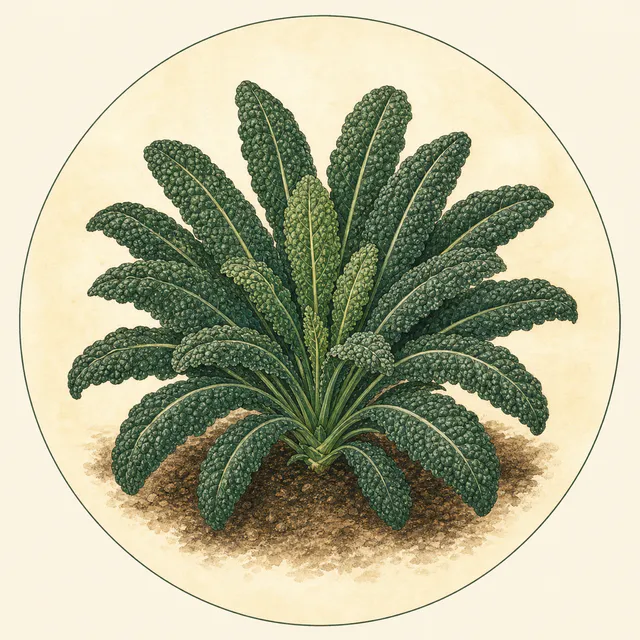
‘Yurok’ is a leafy biennial usually grown as an annual vegetable for its edible foliage. This F1 Tuscan-style kale forms short, uniform, productive plants with compact rosettes of narrow, very dark green leaves. The surfaces carry small blisters that give the leaves a restrained puckered texture rather than the dense frills of traditional curly kale.
The compact habit suits small plots and containers. Leaves can be harvested from September through February. The RHS profile displays an Award of Garden Merit, although its botanical name status is currently recorded as unresolved.
Size
- Ultimate height
- 0.5–1 metre
- Ultimate spread
- 0.5–1 metre
- Time to ultimate size
- 1 year
The exact profile's broad measurement bands contain a cultivar described as short and uniform. Allow enough width for the rosette to develop evenly and preserve airflow, while using its compact habit where a taller open kale would be impractical.
Growing conditions
- Suitable soils
- Chalk, clay, loam or sand
- Moisture
- Moist but well-drained
- Soil pH
- Neutral or alkaline
‘Yurok’ accepts a broad range of soil textures but prefers good drainage and non-acid conditions. Enrich the bed before planting, mulch established plants and water regularly during dry periods so the dark leaves remain productive.
Position and hardiness
- Light
- Full sun or partial shade
- Aspect
- East-, south- or west-facing
- Exposure
- Exposed or sheltered
- Hardiness
- H5 — hardy in most UK places even through severe winters
The H5 rating supports the September-to-February harvest window. Full sun gives sturdy compact plants, while partial shade is tolerated. Its short uniform form is useful in exposed sites, although firm planting still prevents winter wind-rock.
Colour and seasonal interest
The edible rosette is very dark green throughout the harvest season. Narrow leaf blades have many small surface blisters and gentle puckering, giving them a Tuscan appearance without the long architectural scale of ‘Nero di Toscana’ or the heavily frilled margins of borecole. The consistent compact rosette is the cultivar's strongest visual identifier.
Botanical details
- Family
- Brassicaceae
- Native to Great Britain and Ireland
- No
- Foliage
- Evergreen
- Habit
- Clump forming
- Name status
- Unresolved
How to grow
Cultivation
Grow in fertile, moisture-retentive but well-drained neutral or alkaline soil. Sow in spring, raise seedlings in modules or pots, and transplant to firm ground in late spring or early summer. Mulch established plants and water in dry spells. Protect the compact rosettes with fine mesh against birds and insects.
Remove young leaves from the main crown from mid-autumn onwards, always leaving the growing point intact. Side shoots can be picked from mid-winter into late spring, extending production beyond the main September-to-February leaf harvest.
Propagation
Propagate by seed. Sow about 1cm deep and transplant with minimal root disturbance once plants are large enough to handle.
Suggested locations
- Small vegetable plot
- Patio or container planting
- Exposed productive bed
- Edible border
Pruning
Harvest young crown leaves from mid-autumn and side shoots from mid-winter to late spring. Remove yellowing or damaged lower foliage to improve airflow.
Pests
May be susceptible to cabbage caterpillars, cabbage root fly, cabbage whitefly, mealy cabbage aphids, flea beetles, slugs and snails.
Diseases
May be susceptible to black rot, downy mildew, foot and root rot, grey moulds, leaf spot and white blister. Rotation, firm spacing and clean removal of old leaves reduce pressure.