
Shallots · Variety guide
Allium cepa (Aggregatum Group) ‘Meloine’ PBR
Shallot ‘Meloine’
This Allotment Pro editorial draft summarises the cited RHS cultivar profile and its linked crop guidance. Check the sources and adjust cultivation decisions for local conditions.Read the original RHS source
Overview
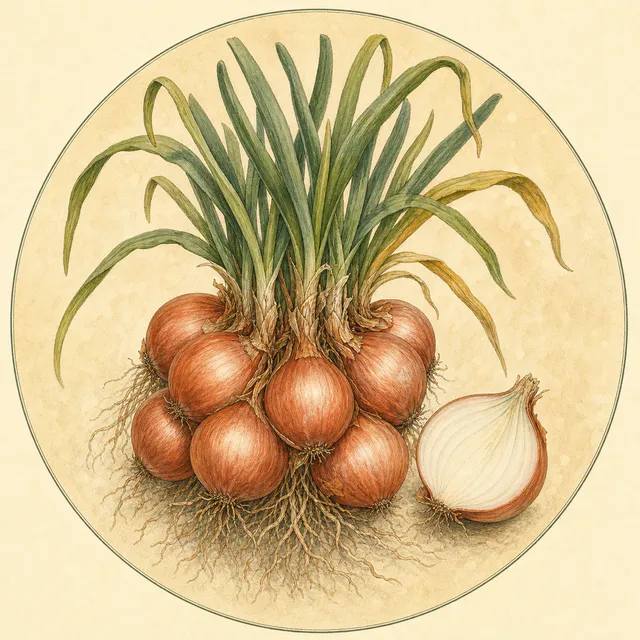
‘Meloine’ is a heavy-cropping annual shallot with a subtle sweet flavour milder than many onions. It forms rounded bulbs with reddish-brown skins and crisp white flesh, developing a mature cluster of up to eight daughter bulbs from one set.
The cultivar shows some resistance to onion downy mildew and suits deep containers as well as open ground. Its combination of rounded clustered bulbs and mild flavour distinguishes it from seed-raised single-bulb Matador.
Size
- Ultimate height
- 0.1–0.5 metres
- Ultimate spread
- 0.1–0.5 metres
- Time to ultimate size
- One year
- Habit
- Clump forming
Give each plant enough room for the cluster to expand to as many as eight bulbs. The upright foliage remains compact above the developing group.
Growing conditions
- Suitable soils
- Clay, loam or sand
- Moisture
- Moist but well drained
- Soil pH
- Neutral
Grow in fertile soil that holds steady moisture while draining freely. Deep containers are suitable, particularly where garden ground remains damp, but must have reliable drainage.
Position and hardiness
- Light
- Full sun
- Aspect
- South- or west-facing
- Exposure
- Sheltered
- Hardiness
- H3 — best suited to coastal and relatively mild parts of the UK
Full sun and shelter encourage strong bulb formation and ripening. In colder districts, spring planting gives the H3 crop a more reliable growing season.
Colour and seasonal interest
| Season | Flowers | Foliage | Bulbs |
|---|---|---|---|
| Spring | Remove if formed | Green | Developing cluster |
| Summer | Remove if formed | Green, then yellowing | Reddish-brown skin, white flesh |
| Autumn | — | Deciduous | Reddish-brown stored crop |
| Winter | — | — | Stored crop |
The mature crop is a tight group of rounded reddish-brown bulbs. A cut bulb reveals crisp white layered flesh, and the intact bulbs are more compact than banana or torpedo shallots.
Botanical details
- Family
- Amaryllidaceae
- Native to Great Britain and Ireland
- No
- Foliage
- Deciduous
- Habit
- Clump forming
- Name status
- Accepted
- Plant Breeders’ Rights
- Yes
- RHS recognition
- Award of Garden Merit
How to grow
Cultivation
Grow in fertile, moist but well-drained soil in full sun on a sheltered site. Plant sets in spring or propagate from seed, keep plants weed-free and water during dry growth. Remove flower stems as soon as they form so energy remains focused on the bulb cluster. Deep containers are suitable.
Propagation
Propagate from seed or by planting sets in spring. The live profile currently displays this propagation text beneath its pruning label, but its meaning is retained here under the appropriate heading.
Suggested locations
- Patio container
- Allotment or kitchen garden
- Sunny raised bed
- Sheltered edible border
Pruning
No routine pruning is required. Remove flower stems as they begin to form, and allow foliage to yellow naturally before harvest.
Pests
Birds may pull young sets from the ground. Cover with fleece until bulbs have rooted securely and replant any that are displaced.
Diseases
May be susceptible to onion white rot and leek rust. ‘Meloine’ shows some resistance to onion downy mildew, although good spacing, airflow and dry foliage remain valuable.