
Salsify · Variety guide
Tragopogon porrifolius ‘Mammoth’
Salsify ‘Sandwich Island Mammoth’
This Allotment Pro editorial draft summarises the cited RHS cultivar profile and its linked crop guidance. Check the sources and adjust cultivation decisions for local conditions.Read the original RHS source
Overview
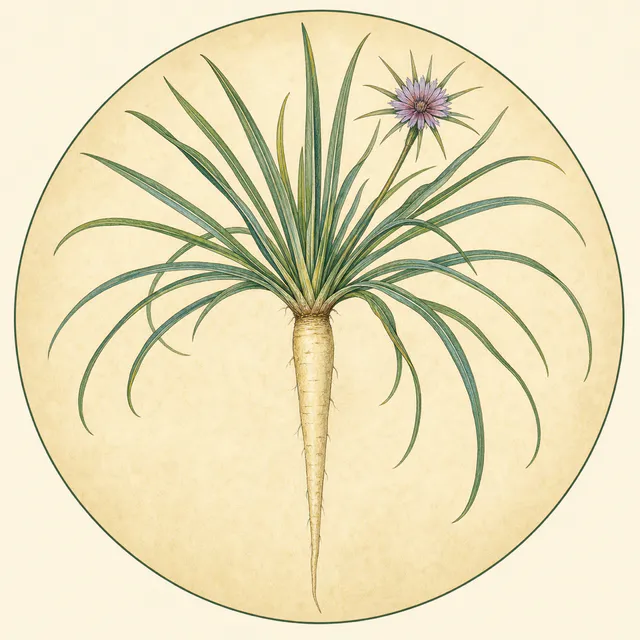
‘Mammoth’ is a biennial salsify selected for large, fleshy edible taproots with an improved flavour. It is also sold as ‘Sandwich Island Mammoth’ or ‘Sandwich Island’ and is described as one of the tastiest forms. The roots are best in their first winter before flowering and remain in useful condition until March.
Plants carried into their second year become ornamental as well as edible. Mauve flowerheads open above long blue-green leaves, with a striking star of elongated green sepals around the petals.
Size
- Ultimate height
- 0.5–1 metre
- Ultimate spread
- 0.1–0.5 metres
- Time to ultimate size
- 1–2 years
- Habit
- Columnar and upright
The first-year crop is dominated by its long taproot and narrow leaf crown. Second-year flowering stems account for the greater ultimate height.
Growing conditions
- Suitable soils
- Clay, loam or sand
- Moisture
- Moist but well drained
- Soil pH
- Acid, alkaline or neutral
Use deep, stone-free soil so the large edible taproot can extend without forking. Keep moisture steady but allow surplus water to drain. Although clay is listed as suitable, compacted or waterlogged ground should be loosened and improved before sowing.
Position and hardiness
- Light
- Full sun
- Aspect
- East-, north-, south- or west-facing
- Exposure
- Sheltered
- Hardiness
- H4 — hardy through most of the UK
- Drought resistance
- Yes once established
Good light and a sheltered position support straight vigorous growth. Its H4 rating allows roots to remain in suitable ground through an average winter, although wet or severely cold sites may require lifting or protection.
Colour and seasonal interest
| Season | Flowers | Foliage | Edible root |
|---|---|---|---|
| Spring | — | Blue-green | Creamy white |
| Summer | Mauve in the second year | Blue-green | — |
| Autumn | — | Blue-green | Creamy white |
| Winter | — | Blue-green | Creamy white |
Long, narrow blue-green leaves form an upright crown above the pale, fleshy taproot. Second-year flowerheads have mauve petals framed by conspicuously long green sepals.
Botanical details
- Family
- Asteraceae
- Native to Great Britain and Ireland
- No
- Foliage
- Evergreen
- Habit
- Columnar upright
- Name status
- Unresolved
- Synonym
- Tragopogon porrifolius ‘Mammoth’
How to grow
Cultivation
Grow in full sun and deep, well-prepared soil. Direct sow fresh seed in spring because transplanting can fork the taproot. Keep the crop weed-free and watered in prolonged dry weather, then lift carefully from mid-autumn through March while roots are still in their first winter and before flowering.
Propagation
Propagate from seed.
Suggested locations
- Cottage or informal garden
- Mediterranean-style planting
- Allotment or kitchen garden
- Deep productive container
Pruning
No pruning is required. Remove faded second-year flowerheads if self-seeding is not wanted.
Pests
Generally pest-free. Young plants can still be protected from slugs and snails in line with the linked crop guidance.
Diseases
Generally disease-free. Prevent physiological root splitting and forking through even moisture, stone-free soil and careful direct sowing.