
Shallots · Variety guide
Allium cepa (Cepa Group) ‘Zebrune’
Onion ‘Zebrune’
This Allotment Pro editorial draft summarises the cited RHS cultivar profile and its linked crop guidance. Check the sources and adjust cultivation decisions for local conditions.Read the original RHS source
Overview
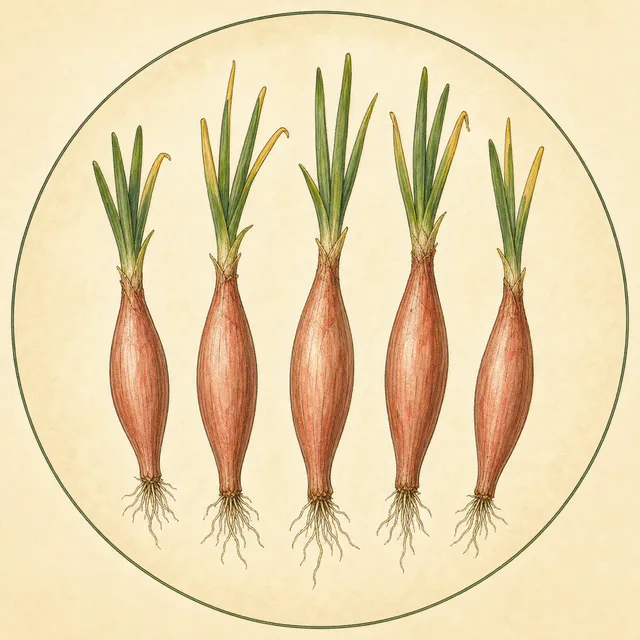
‘Zebrune’ is a heritage seed-raised shallot with long torpedo-shaped bulbs, brownish-pink skins and a particularly fine flavour prized for gourmet cooking. It stores well and has good resistance to bolting, making it a reliable elongated alternative to rounded shallots.
Best raised directly from seed, the cultivar develops as an annual crop. Its crisp elongated bulbs taper toward both the neck and root plate, producing the characteristic French banana or torpedo outline.
Size
- Ultimate height
- 0.1–0.5 metres
- Ultimate spread
- 0.1–0.5 metres
- Time to ultimate size
- One year
- Habit
- Clump forming
Plants remain compact above ground, but allow the specified row and final seedling spacing for straight, evenly ripened bulbs and good airflow.
Growing conditions
- Suitable soils
- Chalk, clay, loam or sand
- Moisture
- Well drained
- Soil pH
- Alkaline or neutral
Use fertile soil that drains freely. Fine, level ground supports even direct sowing and straight bulb development. Avoid saturated beds that promote allium diseases.
Position and hardiness
- Light
- Full sun
- Aspect
- South- or west-facing
- Exposure
- Sheltered
- Hardiness
- H3 — best suited to coastal and relatively mild parts of the UK
A sunny sheltered position supports strong early growth and full ripening. The crop’s resistance to bolting improves reliability, but cold or severely exposed sites can still delay establishment.
Colour and seasonal interest
| Season | Flowers | Foliage | Bulbs |
|---|---|---|---|
| Spring | — | Green | Developing |
| Summer | — | Green, then yellowing | Brownish pink |
| Autumn | — | Deciduous | Brownish-pink stored crop |
| Winter | — | — | Stored crop |
The signature harvest is a group of elegant, narrow torpedo bulbs wrapped in warm brownish-pink papery skins. The form is more slender and sharply tapered than a conventional rounded shallot.
Botanical details
- Family
- Amaryllidaceae
- Native to Great Britain and Ireland
- No
- Foliage
- Deciduous
- Habit
- Clump forming
- Name status
- Unresolved
- RHS recognition
- Award of Garden Merit
How to grow
Cultivation
Sow outdoors from late March through April in well-drained soil in full sun. Sow thinly about 1cm deep in rows 30cm apart. Once seedlings are large enough to handle, thin them to 4cm. Cover the young crop with biodegradable fleece to deter birds and insects, keep rows weed-free and water in dry conditions.
Propagation
Propagate from seed.
Suggested locations
- Allotment or kitchen garden
- Sunny raised bed
- Sheltered edible border
- Heritage vegetable plot
Pruning
No pruning is required. Allow foliage to yellow and flop naturally before harvest.
Pests
May be susceptible to onion fly. Birds may pull young bulbs and seedlings from the soil, so protect the row with fleece until well established.
Diseases
May be susceptible to onion white rot, leek rust and onion downy mildew. Rotate allium crops, maintain airflow and use freely drained ground.