
Kohlrabi · Variety guide
Brassica oleracea (Gongylodes Group) ‘Kossak’
Kohlrabi ‘Kossak’
This Allotment Pro editorial draft summarises the cited RHS cultivar profile. Check the source and adjust cultivation decisions for local conditions.Read the original RHS source
Overview
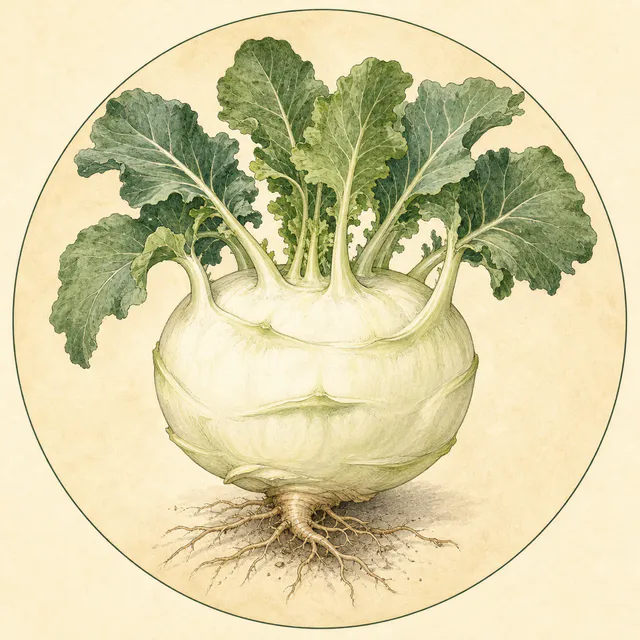
‘Kossak’ is a large, fast-growing white kohlrabi with a mild taste. Its substantial pale white-to-green swollen stem develops beneath a tuft of green brassica foliage and is ready to eat in about three months.
The unusually large edible globe and pale colouring are the most useful visual distinctions from smaller green or purple cultivars. Despite its size, it is selected for mild flavour rather than an aggressively strong brassica taste.
Size
- Ultimate height
- 0.1–0.5 metre
- Ultimate spread
- 0.1–0.5 metre
- Time to ultimate size
- 1 year
The RHS dimensions describe the leafy plant, while the cultivar description highlights its large swollen stem. Give plants enough space and steady growing conditions to develop a broad, even globe.
Growing conditions
- Suitable soils
- Chalk, clay, loam or sand
- Moisture
- Moist but well-drained
- Soil pH
- Acid, neutral or alkaline
‘Kossak’ tolerates a broad range of soil textures and pH values. For the best edible stems, use firm, fertile ground that holds useful moisture without becoming waterlogged, and avoid growth checks while the globe is expanding.
Position and hardiness
- Light
- Full sun
- Aspect
- East-, north-, south- or west-facing
- Exposure
- Exposed or sheltered
- Hardiness
- H5 — hardy in most places throughout the UK, even in severe winters
Full sun is the main positional requirement. The wide aspect and exposure tolerance, H5 rating and suitability for coastal regions make this a robust cultivar, although it is normally harvested in its first growing season.
Colour and seasonal interest
The large swollen stem is described as white kohlrabi, with pale white-to-light-green skin and mild flesh. Green foliage forms a tuft above and around the globe. White stem colour is noted in summer and autumn, with green foliage through the growing season; flowers are not part of the normal harvest-stage display.
Botanical details
- Family
- Brassicaceae
- Native to Great Britain and Ireland
- No
- Foliage
- Evergreen
- Habit
- Tufted
- Name status
- Accepted
How to grow
Cultivation
Grow in full sun in firm, fertile soil; the RHS notes that coastal regions are suitable. Maintain consistent moisture throughout its rapid three-month development, especially while the large globe is swelling. Firm plants after transplanting or soil disturbance so roots retain close contact with the ground.
Harvest when the substantial pale stem is fully formed but still mild and tender. Do not judge readiness from foliage height alone: inspect the swollen stem and avoid leaving it until texture becomes coarse.
Propagation
Propagate by seed. Sow into prepared fertile ground or raise young plants for transplanting, keeping the root disturbance minimal.
Suggested locations
- Sunny vegetable plot
- Coastal allotment
- Raised bed with moisture-retentive soil
- Open productive border
Pruning
No pruning is required. Remove only damaged leaves and harvest the entire swollen stem.
Pests
Young plants may be susceptible to flea beetle, small white butterfly caterpillars, cabbage root fly, mealy cabbage aphid and pigeons.
Diseases
May be susceptible to brassica downy mildew and brassica white blister. Club root can build up where brassicas have previously grown, so use rotation and maintain suitable soil conditions.