
Beetroot · Variety guide
Beta vulgaris ‘Barbietola di Chioggia’
Beetroot ‘Chioggia’
This Allotment Pro editorial draft summarises the cited RHS cultivar profile. Check the source and adjust cultivation decisions for local conditions.Read the original RHS source
Overview
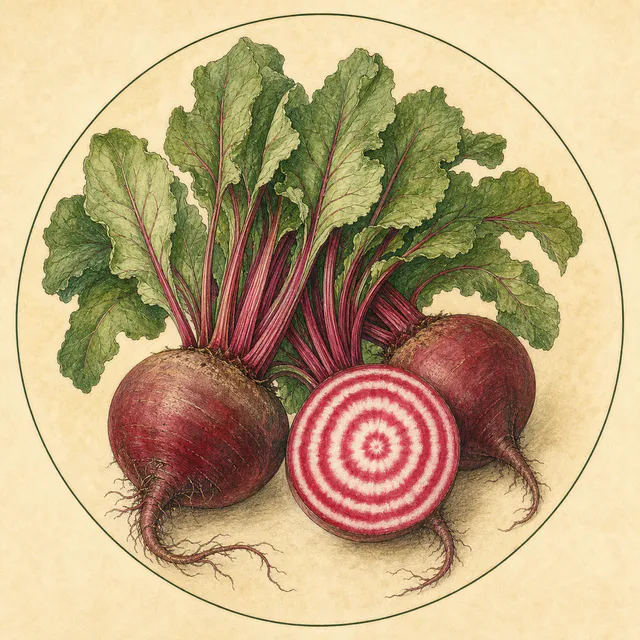
‘Barbietola di Chioggia’, shown as ‘Babietola di Chioggia’ in the parent crop guide, is a reliable annual beetroot grown for attractive edible taproots. The rounded roots are crimson outside, but a transverse cut reveals their defining pattern of alternating white and red concentric rings.
The roots are described as very tasty and particularly suited to roasting, which preserves a broad slice on which the inner rings can be displayed. Above ground, the cultivar forms a compact clump of green foliage during its single growing season.
Size
- Ultimate height
- 0.1–0.5 metres
- Ultimate spread
- 0.1–0.5 metres
- Time to ultimate size
- 1 year
This low beetroot completes its growth within one year. Its modest height and spread come from the basal leaf rosette surrounding the swelling root.
Growing conditions
- Suitable soils
- Loam and sand
- Moisture
- Moist but well-drained or well-drained
- Soil pH
- Alkaline or neutral
Provide fertile soil with free drainage and an alkaline to neutral reaction. Maintain enough moisture for steady growth without letting the root zone become waterlogged.
Position and hardiness
- Light
- Full sun
- Aspect
- South- or west-facing
- Exposure
- Sheltered
- Hardiness
- H3 — hardy in coastal and relatively mild UK locations, although cultivated here as an annual edible crop
A sunny and sheltered site supports reliable root development. Despite its H3 rating, the plant reaches maturity in one season and is normally harvested rather than retained over winter.
Colour and seasonal interest
| Season | Flowers | Foliage | Fruit |
|---|---|---|---|
| Spring | — | Green | — |
| Summer | Green | Green | — |
| Autumn | — | Green | — |
| Winter | — | — | — |
The live profile lists green foliage from spring through autumn and green flowers in summer. The edible crimson taproot, with white and red rings inside, is the cultivar’s main visual distinction even though root colour is not represented in the seasonal table. An em dash means no colour is listed for that field.
Botanical details
- Family
- Amaranthaceae
- Native to Great Britain and Ireland
- No
- Foliage
- Deciduous
- Habit
- Clump-forming
- Name status
- Accepted
How to grow
Cultivation
Grow in fertile, well-drained alkaline soil in full sun. If the soil is low in humus, dig the bed in autumn and add well-rotted manure. Sow directly from March to July in drills 2.5cm (1in) deep, cover lightly with soil, and thin seedlings to 10cm (4in) apart.
Propagation
Propagate from seed. Keep the sowing evenly moist through germination and allow each retained seedling sufficient room to form a rounded root.
Pruning
No pruning is required. The profile advises harvesting roots once they are more than 5cm (2in) in diameter.
Pests
The cultivar may be susceptible to aphids, flea beetles and mangold fly, also called beet leaf miner. Monitor foliage for sap-feeding colonies, small feeding holes and pale mines within the leaf tissue.
Diseases
Possible diseases listed by the profile are beetroot heart rot, black leg and leaf spot. Inspect the crop regularly and maintain suitable soil and growing conditions.