
Cauliflowers · Variety guide
Brassica oleracea (Botrytis Group) ‘Veronica’
Cauliflower ‘Veronica’
This Allotment Pro editorial draft summarises the cited RHS cultivar profile. Check the source and adjust cultivation decisions for local conditions.Read the original RHS source
Overview
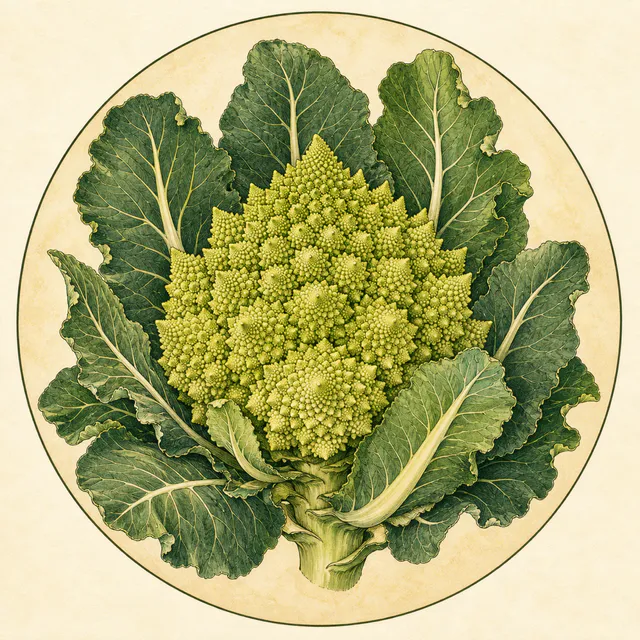
‘Veronica’ is a half-hardy F1 hybrid Romanesco-type cauliflower, technically biennial but normally grown as an annual vegetable. Large deep-green leaves surround an edible lime-green head made from pointed florets densely arranged in geometric whorls. Depending on sowing time, heads are harvested from midsummer into autumn.
Size
- Ultimate height
- 0.1–0.5 metres
- Ultimate spread
- 0.1–0.5 metres
- Time to ultimate size
- 1 year
The compact, bushy plant produces its architectural central head within a single growing cycle.
Growing conditions
- Suitable soils
- Chalk, clay and loam
- Moisture
- Moist but well-drained
- Soil pH
- Alkaline or neutral
Enrich the soil generously with organic matter while preserving good drainage.
Position and hardiness
- Light
- Full sun
- Aspect
- South- or west-facing
- Exposure
- Exposed or sheltered
- Hardiness
- H3 — hardy in coastal and relatively mild UK locations
Choose full sun and plan sowing dates so the lime-green heads mature before severe cold.
Colour and seasonal interest
The edible lime-green head is composed of tightly packed, pointed florets arranged in repeating whorls. Deep-green leaves form a bold frame around this distinctive Romanesco structure from midsummer into autumn.
Botanical details
- Family
- Brassicaceae
- Native to Great Britain and Ireland
- No
- Foliage
- Deciduous
- Habit
- Bushy
- Name status
- Accepted
- Breeder
- Michael John Day
How to grow
Cultivation
Grow in fertile soil enriched with plenty of organic matter. Firm plants well when transplanting so their roots stay stable and growth remains even. Maintain steady moisture during head development.
Propagation
Propagate by seed. As an F1 hybrid, saved seed will not reliably reproduce the cultivar.
Pruning and harvesting
No formative pruning is needed. Harvest while the head remains firm by cutting the entire plant at its base.
Pests
Potential pests include mealy cabbage aphid, cabbage whitefly, cabbage root fly and cabbage caterpillars. Birds may damage seedlings and young leaves.
Diseases
Plants may be susceptible to club root. Rotate brassicas and avoid moving contaminated soil.