
French Beans · Variety guide
Phaseolus vulgaris ‘Boston’ PBR
Bean (dwarf French) ‘Boston’
This Allotment Pro editorial draft summarises the cited RHS cultivar profile. Check the source and adjust cultivation decisions for local conditions.Read the original RHS source
Overview
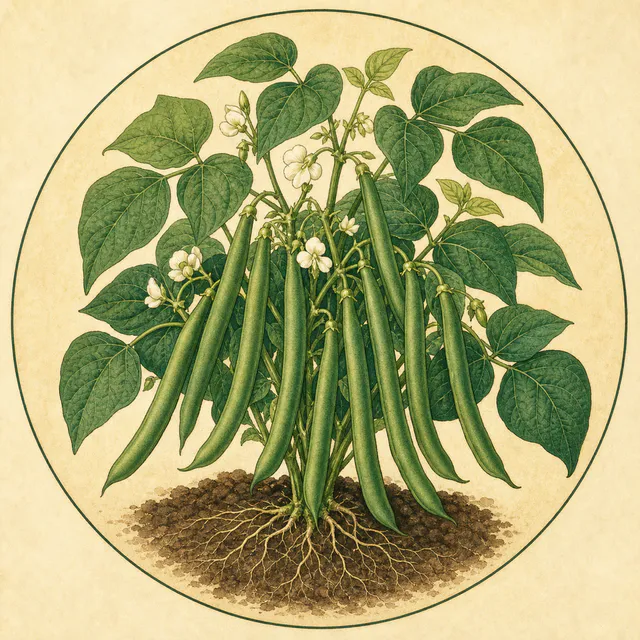
‘Boston’ is an annual dwarf French bean forming a sturdy bush around 45cm tall. Green foliage and white summer flowers are followed by a heavy crop of dark-green cylindrical beans about 15cm long. The pods are tender and noted for excellent flavour.
Its compact self-supporting growth makes it well suited to containers and small beds, where plants can be grouped into blocks. The RHS profile displays the Award of Garden Merit and records Plant Breeders’ Rights.
Size
- Ultimate height
- 0.1–0.5 metre
- Ultimate spread
- 0.1–0.5 metre
- Time to ultimate size
- 1 year
The low bush needs no tall cane structure. Closely spaced plants can support one another, with short twiggy sticks useful only where stems or pods might fall onto the soil.
Growing conditions
- Suitable soils
- Chalk, clay, loam or sand
- Moisture
- Moist but well-drained
- Soil pH
- Acid, neutral or alkaline
‘Boston’ accepts varied soil textures and pH values. Fertile, moisture-retentive ground is most important for sustaining the heavy crop, while drainage prevents the compact root zone from remaining saturated.
Position and hardiness
- Light
- Full sun
- Aspect
- East-, south- or west-facing
- Exposure
- Exposed or sheltered
- Hardiness
- H2 — tolerant of low temperatures but unable to survive freezing
Grow as a tender summer annual after frost. Although the sturdy bush tolerates exposed or sheltered positions, full sun and protection from damaging wind support reliable flowering and straight pod development.
Colour and seasonal interest
| Season | Flowers | Foliage | Fruit |
|---|---|---|---|
| Spring | — | Green | — |
| Summer | White | Green | Dark green |
The 15cm cylindrical dark-green pods are the cultivar’s clearest harvest-stage feature. Pick while smooth, slender and tender, before the individual beans become prominent.
Botanical details
- Family
- Fabaceae
- Native to Great Britain and Ireland
- No
- Foliage
- Deciduous
- Habit
- Bushy
- Name status
- Accepted
How to grow
Cultivation
Grow in fertile, moisture-retentive soil with good light. ‘Boston’ also suits a patio container. Space plants fairly close in wide bands or blocks so neighbouring bushes support each other, then water regularly from flowering and pick the dark-green pods frequently.
Propagation
Propagate by seed.
Suggested locations
- Cottage or informal garden
- Patio container
- Edible bed or allotment
Pruning
No pruning is required. Remove pods by holding the plant steady and cutting or snapping carefully to avoid damaging the compact stems.
Pests
May be susceptible to slugs, snails and blackfly. Protect young seedlings and inspect soft shoot tips and leaf undersides for aphid colonies.
Diseases
May be susceptible to runner and French bean rust. Maintain airflow between blocks and clear infected crop material after harvesting.