
Cauliflowers · Variety guide
Brassica oleracea (Botrytis Group) ‘Triomphant’
Cauliflower ‘Triomphant’
This Allotment Pro editorial draft summarises the cited RHS cultivar profile. Check the source and adjust cultivation decisions for local conditions.Read the original RHS source
Overview
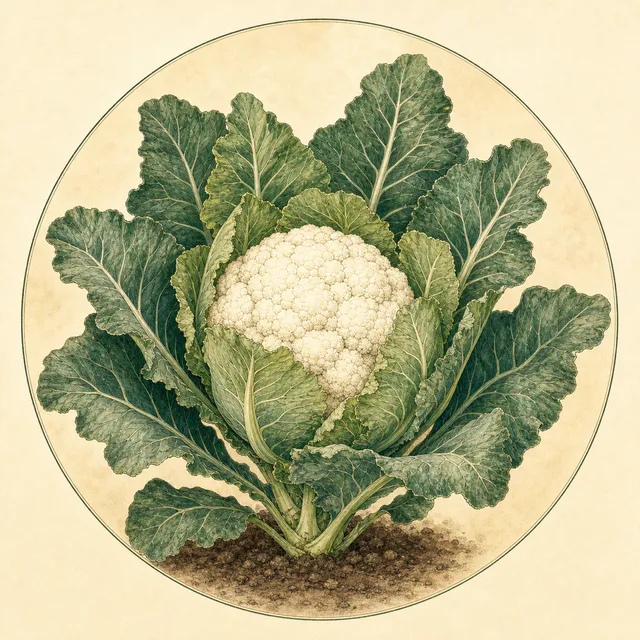
‘Triomphant’ is a winter-cropping cauliflower with pure-white curds held within semi-erect green foliage. Its excellent-flavoured heads are ready from December into January, making it useful for a midwinter harvest when fewer home-grown vegetables are available.
Size
- Ultimate height
- 0.1–0.5 metres
- Ultimate spread
- 0.1–0.5 metres
- Time to ultimate size
- 1 year
This compact, clump-forming brassica completes its productive cycle within a year.
Growing conditions
- Suitable soils
- Loam and sand
- Moisture
- Well-drained
- Soil pH
- Neutral or alkaline
Prepare fertile soil that retains useful moisture without becoming waterlogged in winter.
Position and hardiness
- Light
- Full sun
- Aspect
- South- or west-facing
- Exposure
- Sheltered
- Hardiness
- H4 — hardy through an average UK winter
A sunny, sheltered bed helps plants mature evenly and keeps the white curd protected during exposed winter weather.
Colour and seasonal interest
No seasonal colours are assigned on the source profile. Its distinguishing feature is the pure-white winter curd framed and naturally protected by semi-erect green leaves.
Botanical details
- Family
- Brassicaceae
- Native to Great Britain and Ireland
- No
- Foliage
- Deciduous
- Habit
- Clump-forming
- Name status
- Unresolved
How to grow
Cultivation
Grow in full sun in fertile, moist but well-drained soil. Sow directly between May and June, then transplant seedlings to their final positions by the end of June. Firm plants well so they remain stable through autumn and winter.
Propagation
Propagate by seed, either sown outdoors or started indoors.
Pruning
No pruning is required.
Pests
Potential pests include birds, cabbage caterpillars, cabbage gall weevil, cabbage root fly, cabbage whitefly, cutworms, flea beetle, mealy cabbage aphid, slugs and snails, and swede midge.
Diseases
Possible diseases are black rot, club root, downy mildew, foot and root rot, grey mould, leaf spot and white blister.