
Leeks · Variety guide
Allium porrum ‘Krypton’ PBR AGM
Leek ‘Krypton’ AGM
This Allotment Pro editorial draft summarises the cited RHS cultivar profile. Check the source and adjust cultivation decisions for local conditions.Read the original RHS source
Overview
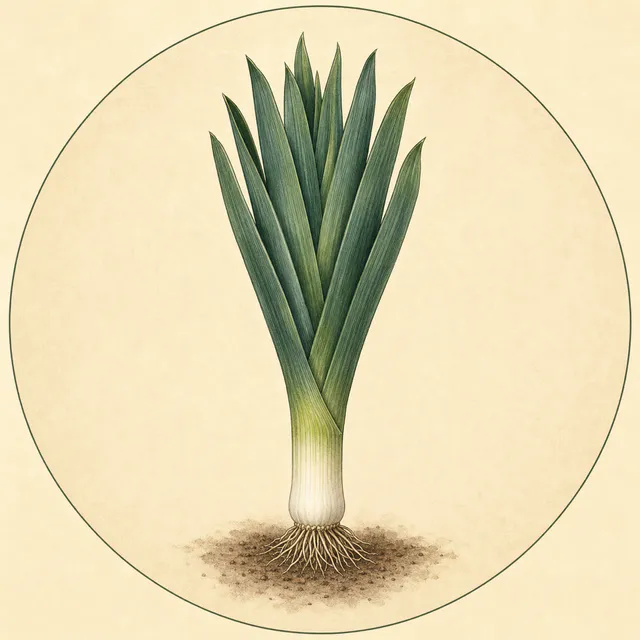
‘Krypton’ is a hardy perennial leek grown as an annual vegetable. It makes compact, upright plants with a mild flavour and excellent disease resistance, suiting smaller plots and close-managed rows. The cultivar may be lifted as tender baby leeks in late summer or allowed to mature for winter harvest.
Its compact vertical form is the central visual identifier: a neat pale shank supports an upright fan of green strap leaves rather than a broad spreading canopy. The RHS profile displays an Award of Garden Merit and Plant Breeders’ Rights status.
Size
- Ultimate height
- 0.1–0.5 metre
- Ultimate spread
- 0.1–0.5 metre
- Time to ultimate size
- 1 year
The narrow upright habit uses space efficiently. Final dimensions depend on whether plants are harvested young as baby leeks or left to develop mature winter shanks.
Growing conditions
- Suitable soils
- Sand, loam, clay or chalk
- Moisture
- Moist but well-drained
- Soil pH
- Neutral or alkaline
Use fertile ground that holds steady moisture while draining freely. Organic matter supports continuous summer growth and helps prevent the checks that reduce shank quality.
Position and hardiness
- Light
- Full sun
- Aspect
- South- or west-facing
- Exposure
- Sheltered
- Hardiness
- H4 — hardy through most of the UK
Full sun develops sturdy upright foliage and mature winter stems. A sheltered position reduces wind damage, while H4 hardiness suits outdoor overwintering across most UK gardens.
Colour and seasonal interest
Green strap-shaped leaves rise vertically from the pale edible shank. Foliage stays green across the growing and harvesting seasons. Baby specimens are slender and tender; mature winter plants have a thicker base but retain the same compact upright outline. Flowers are not part of the intended first-year crop.
Botanical details
- Family
- Amaryllidaceae
- Native to Great Britain and Ireland
- No
- Foliage
- Deciduous
- Habit
- Clump forming
- Name status
- Accepted
How to grow
Cultivation
Grow in fertile, moist but well-drained soil in full sun. Start seed indoors in modules and transplant later, or sow outdoors in March and April and move seedlings into their final positions in early summer.
Use close but adequate spacing for compact plants and maintain steady moisture while roots establish. Lift selected plants in late summer for mild baby leeks, or leave the rest to thicken and mature from December onwards. Earth up carefully if a longer pale shank is wanted, keeping soil out of the leaf fan.
Propagation
Propagate by seed. A uniform module-raised batch is convenient for planting compact orderly rows.
Suggested locations
- Small sunny vegetable plot
- Raised bed
- Compact allotment row
- Baby-leek and winter-harvest succession
Pruning
No pruning is required. Remove only damaged leaf tissue or a premature flower stalk, and harvest the complete plant.
Pests
May be susceptible to leek moth and birds. Protect with fleece or insect-proof netting before adult moths can lay eggs.
Diseases
May be susceptible to onion white rot and leek rust, although ‘Krypton’ is noted for excellent general disease resistance. Continue to rotate crops, avoid contaminated soil and keep foliage dry when watering.