
Cauliflowers · Variety guide
Brassica oleracea (Botrytis Group) ‘Clapton’
Cauliflower ‘Clapton’
This Allotment Pro editorial draft summarises the cited RHS cultivar profile. Check the source and adjust cultivation decisions for local conditions.Read the original RHS source
Overview
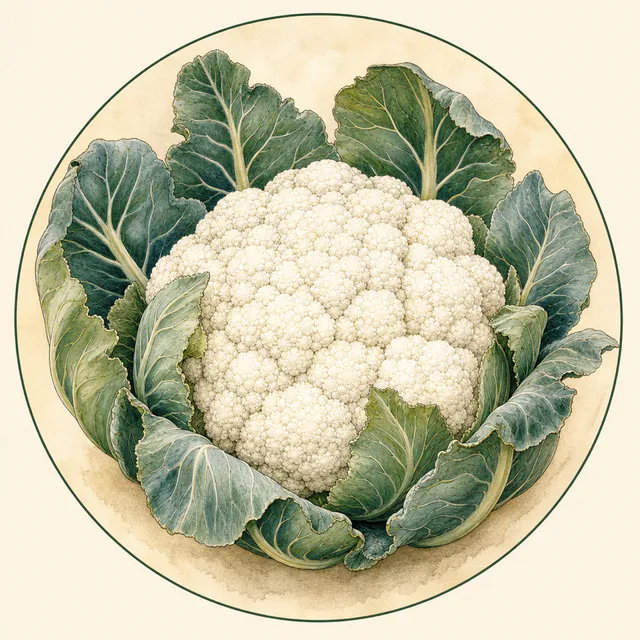
‘Clapton’ is a favoured autumn cauliflower producing large, uniform and solid heads of deep white curd from late summer into autumn. The heads combine excellent flavour with high overall quality.
Its defining agronomic trait is excellent resistance to club root. That makes ‘Clapton’ particularly valuable where this persistent brassica disease is a concern, although rotation and suitable soil preparation remain important.
Size
- Ultimate height
- 0.1–0.5 metres
- Ultimate spread
- 0.1–0.5 metres
- Time to ultimate size
- 1 year
The plant completes its crop in one season, forming a clump of leaves around the large central white head.
Growing conditions
- Suitable soils
- Sand and loam
- Moisture
- Well-drained
- Soil pH
- Alkaline or neutral
Grow in fertile soil that drains freely. Neutral or alkaline conditions suit this brassica and complement the cultivar’s strong club-root resistance.
Position and hardiness
- Light
- Full sun
- Aspect
- West- or south-facing
- Exposure
- Sheltered
- Hardiness
- H3 — hardy in coastal and relatively mild UK conditions, matching its late-summer and autumn cropping period
Choose a sunny, sheltered plot with firm ground so the large head develops without a check in growth.
Colour and seasonal interest
The seasonal table contains no assigned colours. The description identifies a large, uniform, deep-white edible head held within green brassica foliage from late summer into autumn.
Botanical details
- Family
- Brassicaceae
- Native to Great Britain and Ireland
- No
- Foliage
- Deciduous
- Habit
- Clump-forming
- Name status
- Accepted
How to grow
Cultivation
Grow ‘Clapton’ in full sun in fertile, moist but well-drained soil. Sow directly into a well-prepared seedbed from April to June, then transplant carefully into firm final ground without disturbing the roots.
Propagation
Propagate by seed, raised outdoors or started indoors in modules.
Pruning
No pruning is required. Cut the solid white head while the curd remains compact.
Pests
Possible pests include birds, cabbage caterpillars, cabbage gall weevil, cabbage root fly, cabbage whitefly, cutworms, flea beetle, mealy cabbage aphid, slugs and snails, and swede midge. Fine mesh excludes several of these threats.
Diseases
The cultivar shows excellent resistance to club root.