
Leeks · Variety guide
Allium porrum ‘Porbella’ AGM
Leek ‘Porbella’ AGM
This Allotment Pro editorial draft summarises the cited RHS cultivar profile. Check the source and adjust cultivation decisions for local conditions.Read the original RHS source
Overview
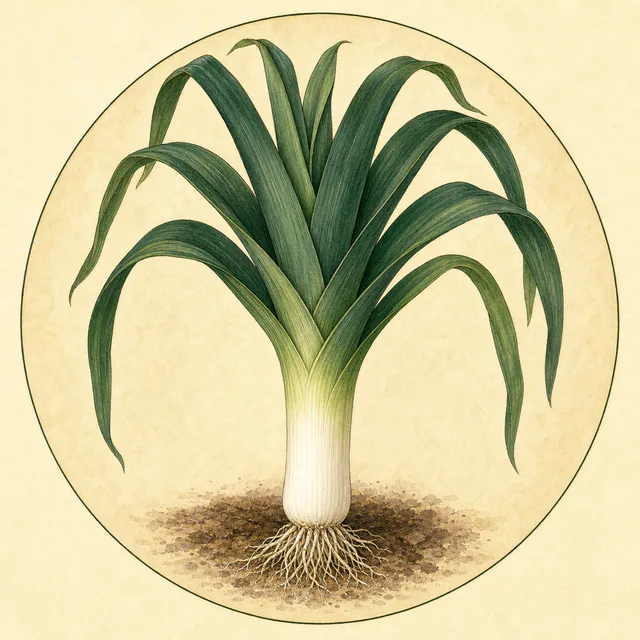
‘Porbella’ is a perennial leek generally grown as an annual. Long lance-shaped dark-green leaves arch as they develop, their overlapping bases forming a thick edible stem that is normally blanched white. This well-flavoured cultivar stands for several months and crops from mid-autumn to late winter.
The thick pure-white shank and arching dark-green leaves distinguish it from narrow upright forms. If left unharvested into another season it can produce a tall flower stem and rounded white umbel, but the illustration and harvest guide focus on the edible first-year plant. The RHS profile displays an Award of Garden Merit.
Size
- Ultimate height
- 0.5–1 metre
- Ultimate spread
- 0.1–0.5 metre
- Time to ultimate size
- 1–2 years
Harvest-stage plants remain narrow but carry long arching foliage. The longer time range includes unharvested plants progressing towards flowering.
Growing conditions
- Suitable soils
- Chalk, clay, loam or sand
- Moisture
- Moist but well-drained
- Soil pH
- Acid, neutral or alkaline
Use well-drained soil rich in organic matter and maintain enough moisture for thick stems. Rotation protects the long-standing winter crop from accumulated allium disease.
Position and hardiness
- Light
- Full sun or partial shade
- Aspect
- East-, south- or west-facing
- Exposure
- Exposed or sheltered
- Hardiness
- H5 — hardy in most places throughout the UK, even in severe winters
Sun is ideal, but shade is tolerated. H5 hardiness and strong standing ability support harvesting through late winter.
Colour and seasonal interest
Long dark-green lance-shaped leaves arch above a thick, clean white shank. The white is produced by excluding light from the wrapped leaf bases. Flowers belong to older unharvested plants and are not part of the normal edible crop.
Botanical details
- Family
- Amaryllidaceae
- Native to Great Britain and Ireland
- No
- Foliage
- Evergreen
- Habit
- Clump forming
- Name status
- Unresolved
How to grow
Cultivation
Grow in well-drained soil rich in organic matter, ideally in sun although shade is tolerated. Start seed in containers or a spring seedbed, then transplant pencil-thick seedlings into holes about 15cm deep. Earthing up as plants grow increases the white shank length.
Keep plants evenly watered and lift from mid-autumn onward. Sound stems can remain for several months, extending harvest into late winter.
Propagation
Propagate by seed. Transplant an even batch at pencil thickness for consistent thick stems.
Suggested locations
- Winter vegetable plot
- Partly shaded productive bed
- Raised bed rich in organic matter
- Long-season allotment row
Pruning
No pruning is required. Remove damaged foliage and any premature flower stalk.
Pests
May be susceptible to slugs and snails, leek moth, onion fly and onion thrips.
Diseases
May be susceptible to leek rust, onion white rot, downy mildews, foot and root rots, fungal leaf spots and smuts.