
Leeks · Variety guide
Allium porrum ‘Stamford’ AGM
Leek ‘Stamford’ AGM
This Allotment Pro editorial draft summarises the cited RHS cultivar profile. Check the source and adjust cultivation decisions for local conditions.Read the original RHS source
Overview
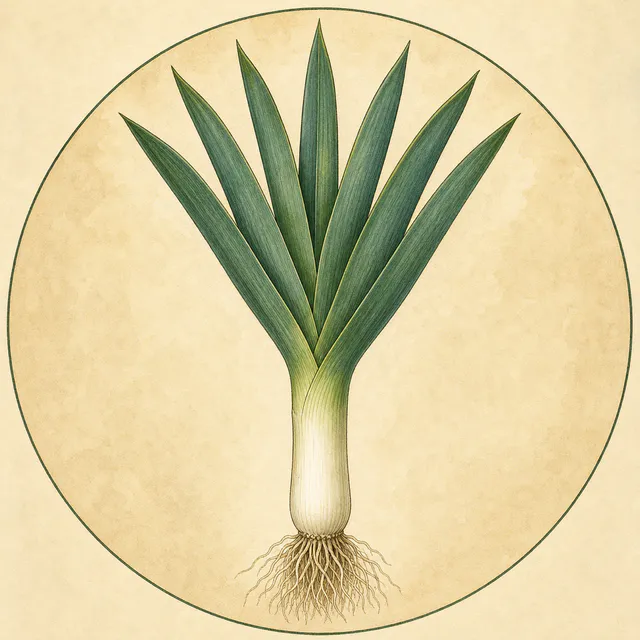
‘Stamford’ is a hardy perennial leek usually grown as an annual vegetable. It has thick, upright blue-green leaves and produces a good yield of uniform stems whose outer leaves are easy to peel. This second-early cultivar can be ready from October, depending on sowing time.
The even pale shanks, thick vertical blue-green foliage and early bulking habit are its main harvest-stage identifiers. The RHS profile displays an Award of Garden Merit, while recording the botanical name status as unresolved.
Size
- Ultimate height
- 0.1–0.5 metre
- Ultimate spread
- 0.1–0.5 metre
- Time to ultimate size
- 1 year
Its compact clump fits orderly vegetable rows. Consistent spacing and moisture help the stems bulk at a similar rate for a uniform October crop.
Growing conditions
- Suitable soils
- Chalk, clay, loam or sand
- Moisture
- Moist but well-drained
- Soil pH
- Acid, neutral or alkaline
Enrich the soil with organic matter so it holds moisture but drains freely. ‘Stamford’ accepts a broad pH range, although allium rotation remains important.
Position and hardiness
- Light
- Full sun or partial shade
- Aspect
- East-, south- or west-facing
- Exposure
- Exposed or sheltered
- Hardiness
- H4 — hardy through most of the UK
Full sun encourages fast, even growth, but partial shade is tolerated. H4 hardiness suits outdoor autumn cropping across most UK gardens.
Colour and seasonal interest
Thick upright leaves mature to blue-green in summer, autumn and winter above smooth pale edible stems. The vertical foliage and consistently sized shanks give a tidy row. Flowers are not part of the intended first-year crop.
Botanical details
- Family
- Amaryllidaceae
- Native to Great Britain and Ireland
- No
- Foliage
- Evergreen
- Habit
- Clump forming
- Name status
- Unresolved
How to grow
Cultivation
Grow in moist but well-drained soil rich in organic matter, preferably in full sun although partial shade is tolerated. Draw soil around the stems in late summer and early autumn to increase the length of blanched shank, keeping soil out of the leaf fans.
Maintain even moisture during rapid bulking and begin checking from October. Lift alternate plants if useful, leaving neighbours to continue thickening.
Propagation
Propagate by seed. Raise an even batch and transplant uniform seedlings together.
Suggested locations
- Sunny vegetable plot
- Raised bed
- Early autumn harvesting row
- Productive allotment bed
Pruning
No pruning is required. Remove only damaged foliage or premature flower stalks.
Pests
May be susceptible to slugs and snails, leek moth, onion fly and onion thrips.
Diseases
May be susceptible to leek rust, onion white rot, downy mildews, foot and root rots, fungal leaf spots and smuts.