
Cabbages · Variety guide
Brassica oleracea (Capitata Group) ‘Winterjewel’
Cabbage ‘Winter Jewel’
This Allotment Pro editorial draft summarises the cited RHS cultivar profile. Check the source and adjust cultivation decisions for local conditions.Read the original RHS source
Overview
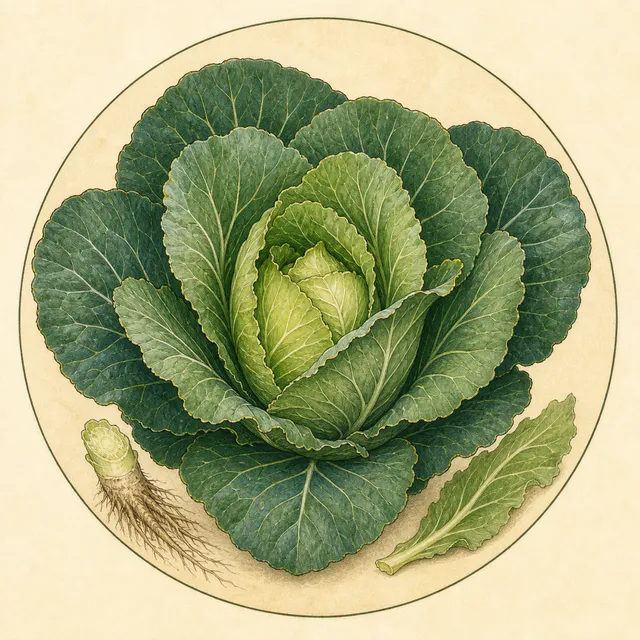
‘Winterjewel’ is a leafy biennial grown as an annual spring cabbage and holds an RHS Award of Garden Merit. It produces smooth, dark-green leaves that can be cut young as spring greens or left in place to develop loose hearts. This two-stage harvest gives the grower flexibility after winter.
The live profile uses cabbage ‘Winter Jewel’ as the common name and also records cabbage ‘Winterjewel’. Its evergreen foliage and compact clump-forming habit distinguish it from a dense, large-headed winter cabbage.
Size
- Ultimate height
- 0.1–0.5 metres
- Ultimate spread
- 0.1–0.5 metres
- Time to ultimate size
- 1 year
The compact dimensions allow a useful row of overwintering plants without the space demanded by large winter drumheads. Leave sufficient room for each loose heart to receive light and airflow.
Growing conditions
- Suitable soils
- Chalk, clay, loam and sand
- Moisture
- Moist but well-drained
- Soil pH
- Neutral or alkaline
‘Winterjewel’ accepts all four common soil textures. The ground should be fertile and firm, retaining steady moisture while draining freely through winter. Neutral or alkaline conditions are preferable where clubroot is a concern.
Position and hardiness
- Light
- Full sun
- Aspect
- South- or west-facing
- Exposure
- Exposed or sheltered
- Hardiness
- H5 — hardy in most UK locations, including severe winters, which supports its use as an overwintering spring cabbage
Plant in an open, sunny position. The live profile accepts exposed as well as sheltered sites, but securely firming the soil and protecting foliage from pigeons will help the compact plants reach spring intact.
Colour and seasonal interest
| Season | Flowers | Foliage | Fruit |
|---|---|---|---|
| Spring | — | Green | — |
| Summer | — | Green | — |
| Autumn | — | Green | — |
| Winter | — | Green | — |
Green evergreen foliage is recorded in every season, with the overview specifying smooth, dark-green leaves. An em dash means that the profile supplies no flower or fruit colour for that season.
Botanical details
- Family
- Brassicaceae
- Native to Great Britain and Ireland
- No
- Foliage
- Evergreen
- Habit
- Clump-forming
- Name status
- Accepted
How to grow
Cultivation
Grow ‘Winterjewel’ in firm, fertile soil in an open, sunny bed. Avoid growing brassicas in the same soil year after year so persistent soil-borne diseases do not build up. Protect the overwintering foliage with fine mesh where pigeons or other pests are active.
Propagation
Propagate by seed. Raise seedlings in modules or a seedbed, then transplant into firm prepared ground.
Pruning
No pruning is required. Harvest selected young leaves as spring greens or allow the plants to form their loose hearts.
Pests
The profile lists cabbage root fly, cabbage caterpillars, cabbage whitefly and mealy cabbage aphid as possible problems. Fine insect-proof mesh provides broad protection.
Diseases
‘Winterjewel’ may be susceptible to clubroot, particularly in acidic soil. Crop rotation, clean transplants, good drainage and an appropriate soil pH help reduce risk.