
Lettuce · Variety guide
Lactuca sativa ‘Rosedale’
Cos lettuce ‘Rosedale’
This Allotment Pro editorial draft summarises the cited RHS cultivar profile. Check the source and adjust cultivation decisions for local conditions.Read the original RHS source
Overview
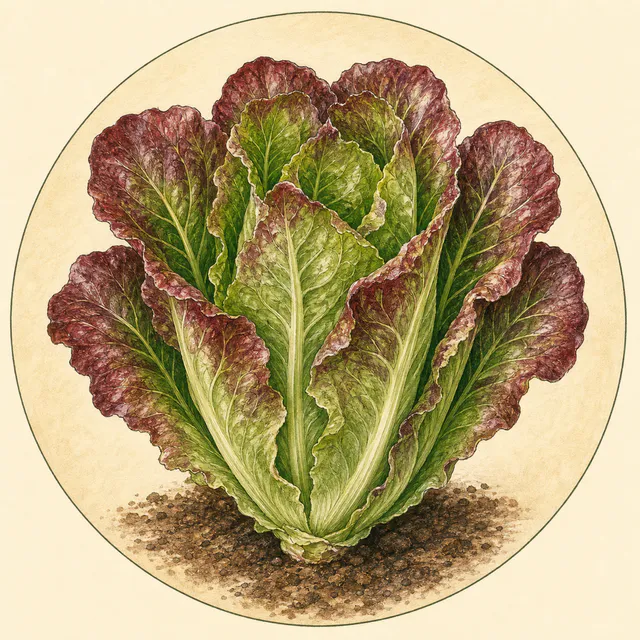
‘Rosedale’ is a modern cos lettuce forming a compact upright rosette of sweet, crunchy leaves. Its most distinctive feature is the foliage: individual leaves are teardrop shaped, green toward the base and centre, and dark red toward their broad wavy margins.
Sow from April to July, or from March under cover, for harvests from May into September. The small upright habit and strong colouring make ‘Rosedale’ useful both as a whole young head and as an ornamental edible among other salad crops.
Size
- Ultimate height
- 0.1–0.5 metre
- Ultimate spread
- 0.1–0.5 metre
- Time to ultimate size
- 1 year
Plants remain compact, but provide enough space for the coloured outer leaves to open without overlapping their neighbours. Good spacing also helps air circulate around the rosette.
Growing conditions
- Suitable soils
- Chalk, clay, loam or sand
- Moisture
- Moist but well-drained
- Soil pH
- Acid, neutral or alkaline
Use fertile soil enriched with organic matter and aim for a near-neutral reaction where possible. Retain steady moisture throughout growth while ensuring surplus water drains freely. Irregular watering can reduce leaf quality and encourage stress.
Position and hardiness
- Light
- Full sun or partial shade
- Aspect
- North-, south-, east- or west-facing
- Exposure
- Sheltered
- Hardiness
- H3 — hardy in coastal and relatively mild parts of the UK
Full sun encourages rich red colouring, while partial shade can moderate heat during midsummer. A sheltered position protects the upright rosette. Use cover for the earliest March sowings and ventilate it on mild days.
Colour and seasonal interest
The sweet crunchy leaves are teardrop shaped, with green centres grading into dark red and burgundy at their broad, noticeably wavy edges. They form a compact upright cos rosette rather than a spherical crisphead or a deeply frilled loose-leaf plant. Harvest from late spring to early autumn before any central flower stem develops.
Botanical details
- Family
- Asteraceae
- Native to Great Britain and Ireland
- No
- Foliage
- Deciduous
- Habit
- Clump forming
- Name status
- Unresolved
How to grow
Cultivation
Work organic matter into fertile, moisture-retentive but well-drained soil, preferably near neutral. Sow outdoors from April to July, or from March under protection. Thin or transplant seedlings promptly so their compact rosettes do not crowd.
Water early in the morning at soil level and maintain even moisture as the leaves expand. Keep weeds down by shallow cultivation, protect young plants, and harvest between May and September according to sowing date. Cut once the coloured leaves are full and crunchy but before the centre elongates.
Propagation
Propagate by seed. Sow small batches in succession for a longer harvest and avoid excessively hot seedbeds, which may inhibit germination.
Suggested locations
- Vegetable plot
- Raised salad bed
- Patio container
- Edible ornamental border
Pruning
No pruning is required. Remove damaged outer leaves and harvest the complete compact rosette when mature.
Pests
May be susceptible to birds, slugs, snails and root aphids. Protect seedlings and inspect beneath the low outer leaves regularly.
Diseases
May be susceptible to grey mould, lettuce downy mildew and, particularly in overwintering crops, lettuce mosaic virus. Use clean seed, avoid crowding and remove affected plants promptly.