
Chinese Cabbage · Variety guide
Brassica rapa (Pekinensis Group) ‘Wong Bok’
Chinese cabbage ‘Wong Bok’
This Allotment Pro editorial draft summarises the cited RHS cultivar profile. Check the source and adjust cultivation decisions for local conditions.Read the original RHS source
Overview
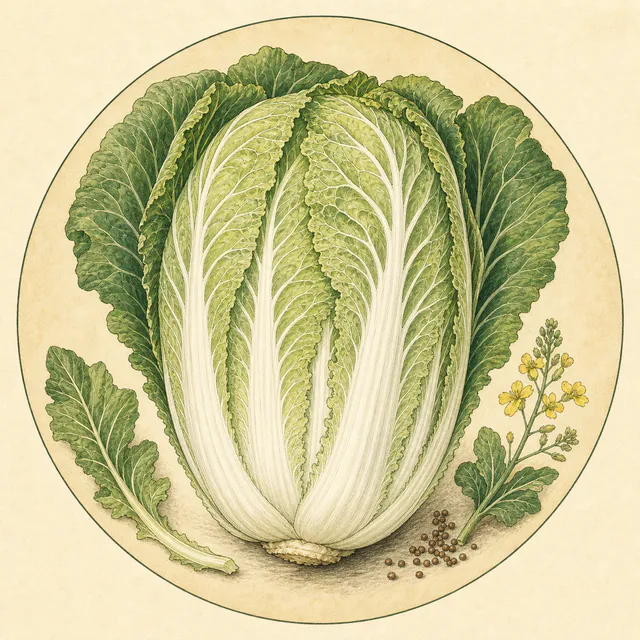
‘Wong Bok’ is one of the largest recommended Chinese cabbages, forming broad barrel-shaped heads. The tightly wrapped leaves make a dense heart, with crisp light-green blades and conspicuously thick white veins.
The cultivar takes about 75 days to reach maturity. Its generous scale and solid internal head distinguish it from smaller compact types, making it a good choice where bed space is available for a substantial harvest.
Size
- Ultimate height
- 0.1–0.5 metre
- Ultimate spread
- 0.1–0.5 metre
- Time to ultimate size
- 1 year
Although the profile places it in the same broad size band as other Chinese cabbages, ‘Wong Bok’ sits at the larger end. Allow full spacing so its outer leaves can support a wide, dense barrel head.
Growing conditions
- Suitable soils
- Chalk, clay, loam and sand
- Moisture
- Moist but well-drained
- Soil pH
- Acid, neutral or alkaline
Use firm, fertile soil that retains water without becoming saturated. Reliable moisture is especially important while the large, tightly wrapped head is filling.
Position and hardiness
- Light
- Full sun
- Aspect
- East-, north-, south- or west-facing
- Exposure
- Exposed or sheltered
- Hardiness
- H5 — hardy in most UK locations, including severe winters at approximately −15 to −10°C
The cultivar tolerates a wide range of aspects and exposure, including coastal sites. Give it full sun and sufficient space to develop its large barrel shape.
Colour and seasonal interest
| Season | Flowers | Foliage | Fruit |
|---|---|---|---|
| Spring | — | Green and white | — |
| Summer | — | Green and white | — |
| Autumn | — | Green and white | — |
The harvest-stage plant is defined by crisp light-green leaves, broad white mid-ribs and the pale interior produced by tightly overlapping foliage.
Botanical details
- Family
- Brassicaceae
- Native to Great Britain and Ireland
- No
- Foliage
- Evergreen
- Habit
- Tufted
- Name status
- Accepted
How to grow
Cultivation
Grow in full sun in firm, fertile soil, including in coastal regions. Prepare a moisture-retentive bed and give each plant the full spacing needed for a large head rather than treating it as a close-planted baby-leaf crop.
Water consistently through its roughly 75-day development. Check the tightly wrapped heart during prolonged damp weather and harvest when the barrel feels dense and well filled.
Propagation
Propagate by seed.
Pruning
No pruning is required. Remove damaged outer foliage only and cut the full barrel head at maturity.
Pests
May be susceptible to flea beetle while young, small white butterfly caterpillars, cabbage root fly, mealy cabbage aphid and pigeons. Secure insect-proof mesh before pests can enter the broad leaf rosette.
Diseases
May be susceptible to brassica downy mildew and brassica white blister. Club root may build up in repeatedly used brassica ground, so rotate crops and prevent movement of contaminated soil.