
Cucumbers · Variety guide
Cucumis sativus ‘Lili’
Cucumber (ridge) ‘Lili’
This Allotment Pro editorial draft summarises the cited RHS cultivar profile. Check the source and adjust cultivation decisions for local conditions.Read the original RHS source
Overview
‘Lili’ is a highly reliable slicing cucumber that can be grown in an unheated greenhouse or outdoors in warmer areas. It produces large crops of attractive dark-green fruits with excellent flavour and good storage ability. The cultivar is predominantly female flowering, so a high proportion of its blooms can develop into cucumbers.
Harvest runs from July to October. Good resistance to downy mildew supports dependable foliage and distinguishes ‘Lili’ from more disease-sensitive cultivars. It holds the RHS Award of Garden Merit.
Size
- Ultimate height
- 1–1.5 metres
- Ultimate spread
- 0.5–1 metre
- Time to ultimate size
- 1 year
The trailing plant benefits from vertical support in a greenhouse or sheltered outdoor position. Its large fruits require secure ties and a strong frame as the crop develops.
Growing conditions
- Suitable soils
- Clay, loam and sand
- Moisture
- Moist but well-drained
- Soil pH
- Acid, neutral or alkaline
Use fertile soil or good-quality potting compost that retains steady moisture but drains freely. Water little and often so the plant does not experience sudden drought or waterlogging.
Position and hardiness
- Light
- Full sun
- Aspect
- West- or south-facing
- Exposure
- Sheltered
- Hardiness
- H2 — tolerant of cool conditions around 1–5°C but unable to survive freezing
An unheated greenhouse provides reliable protection, while outdoor planting is suitable only in a warm, sunny and sheltered area after frost. The cultivar is tender even though it tolerates cooler protected conditions than some greenhouse cucumbers.
Colour and seasonal interest
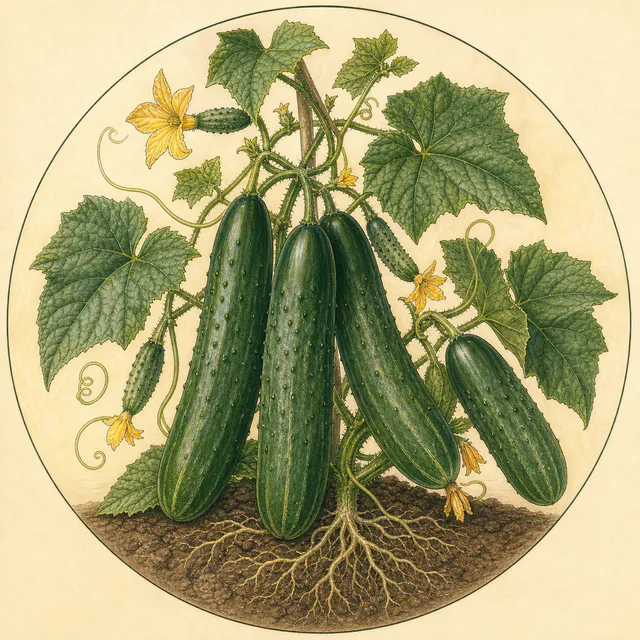
Green trailing foliage and yellow flowers frame large, handsome dark-green slicing cucumbers. Predominantly female flowers show a tiny developing fruit behind their petals. The deep fruit colour, generous size and July-to-October season are its main visual and cropping characteristics.
Botanical details
- Family
- Cucurbitaceae
- Native to Great Britain and Ireland
- No
- Foliage
- Deciduous
- Habit
- Trailing
- Name status
- Accepted
How to grow
Cultivation
Sow in a heated greenhouse or in pots on a sunny windowsill, keeping seed at a constant 21°C to germinate. Pot young plants individually into 25cm pots of good-quality compost and maintain 12–15°C while they establish.
Water little and often to keep the compost evenly moist, and feed every two weeks during active growth. Move plants into an unheated greenhouse or a warm sheltered outdoor site only after frost risk has passed. Support the trailing stems and pick from July to October while fruits are firm and dark green.
Propagation
Propagate by seed.
Suggested locations
- Patio and container plants
- Conservatory and greenhouse
- Warm, sheltered outdoor vegetable beds
Pruning
Pinch out the main growing point once it reaches the top of the support. Shorten side-shoots to two leaves beyond each developing fruit so the plant directs energy towards its crop.
Pests
May be susceptible to glasshouse whitefly, glasshouse red spider mite, slugs and snails. Inspect foliage and protect young outdoor plants.
Diseases
May be susceptible to cucumber mosaic virus. ‘Lili’ shows good resistance to downy mildew, a useful cultivar advantage, although airflow, hygiene and dry foliage remain important.